The standard sizes at a glance
| Rink type | Length | Width | Area | Governing body |
|---|---|---|---|---|
| NHL / North American hockey | 200 ft (60.96 m) | 85 ft (25.9 m) | ~17,000 sq ft (~1,580 m²) | NHL |
| International / Olympic hockey | ~197 ft (60 m) | 98.4 ft (30 m) | ~19,375 sq ft (~1,800 m²) | IIHF |
| Figure skating (recommended) | ~197 ft (60 m) | 98.4 ft (30 m) | ~18,700 sq ft (~1,740 m²) | ISU |
| Figure skating (minimum) | ~184 ft (56 m) | 85 ft (26 m) | ~15,700 sq ft (~1,460 m²) | ISU |
| Short-track speed skating | ~197 ft (60 m) | 98.4 ft (30 m) | same as Olympic sheet | ISU |
| Long-track speed skating | 400 m oval | 4 m lanes | oval track | ISU |
| Curling sheet | up to ~150 ft (45.7 m) | ~14.5-16.5 ft (4.4-5.0 m) | per sheet | World Curling |
| Backyard / recreational (typical) | 20-60 ft (6-18 m) | 40-100 ft (12-30 m) | varies | none |
Swipe or scroll sideways to compare all columns.
NHL and North American hockey rink dimensions
A standard NHL rink is 200 feet long by 85 feet wide (60.96 m by 25.9 m), a playing surface of about 17,000 square feet. The four corners are rounded on a 28-foot (8.5 m) radius, the boards stand 40 to 48 inches high, each goal line sits 11 feet (3.4 m) from the end boards, and the two blue lines are 75 feet from the end boards and 50 feet apart, dividing the ice into defensive, neutral and offensive zones. This is the size used across professional and most amateur hockey in North America. Full markings are on the Hockey rink dimensions page.
International and Olympic hockey rink dimensions
International hockey follows IIHF rules: 60 metres long by 30 metres wide (about 197 by 98.4 feet), roughly 13 feet wider than an NHL sheet, with a corner radius of 7 to 8.5 metres. IIHF rules allow a width range of 26 to 30 metres, and the widest, 30 metres, is used at the Olympics and top international events (the Milano Cortina 2026 Games use a 60 by 26 m sheet). The extra width opens the game up for skating and puck movement, which is why European and international hockey is often described as more open than the NHL game.
Figure skating rink size
The International Skating Union sets figure skating dimensions. The recommended and maximum surface is 60 by 30 metres (about 197 by 98 feet), the same footprint as an Olympic hockey sheet, and the minimum for ISU competition is 56 by 26 metres (about 184 by 85 feet). The same 60 by 30 metre surface is used for short-track speed skating. In practice, most figure skating takes place on standard hockey-sized rinks rather than dedicated ones.
Speed skating rink size
Speed skating uses two surfaces: short-track, on the same 60 by 30 metre sheet as an Olympic hockey or figure skating rink, and long-track, on a 400 metre oval. Both are among the fastest disciplines on ice, which makes them a new frontier for synthetic ice rather than an established use. Glice has already tested it: Tomas Gustafson, the Swedish speed skater who won three Olympic golds, two of them at the Calgary 1988 Games, tested Glice on speed skates in Calgary, and it performed well. No one has yet built a full speed-skating dome on synthetic ice, and Glice is looking for the pioneer who will build the first.
Curling sheet dimensions
A standard curling sheet is long and narrow: up to about 150 feet (45.7 m) long and 14.5 to 16.5 feet (4.4 to 5.0 m) wide, and a facility usually sets several sheets side by side. That is the size to plan for; the full markings, the house, the hog lines and the tee lines, are on the Curling rink dimensions page.
Recreational and public rink sizes
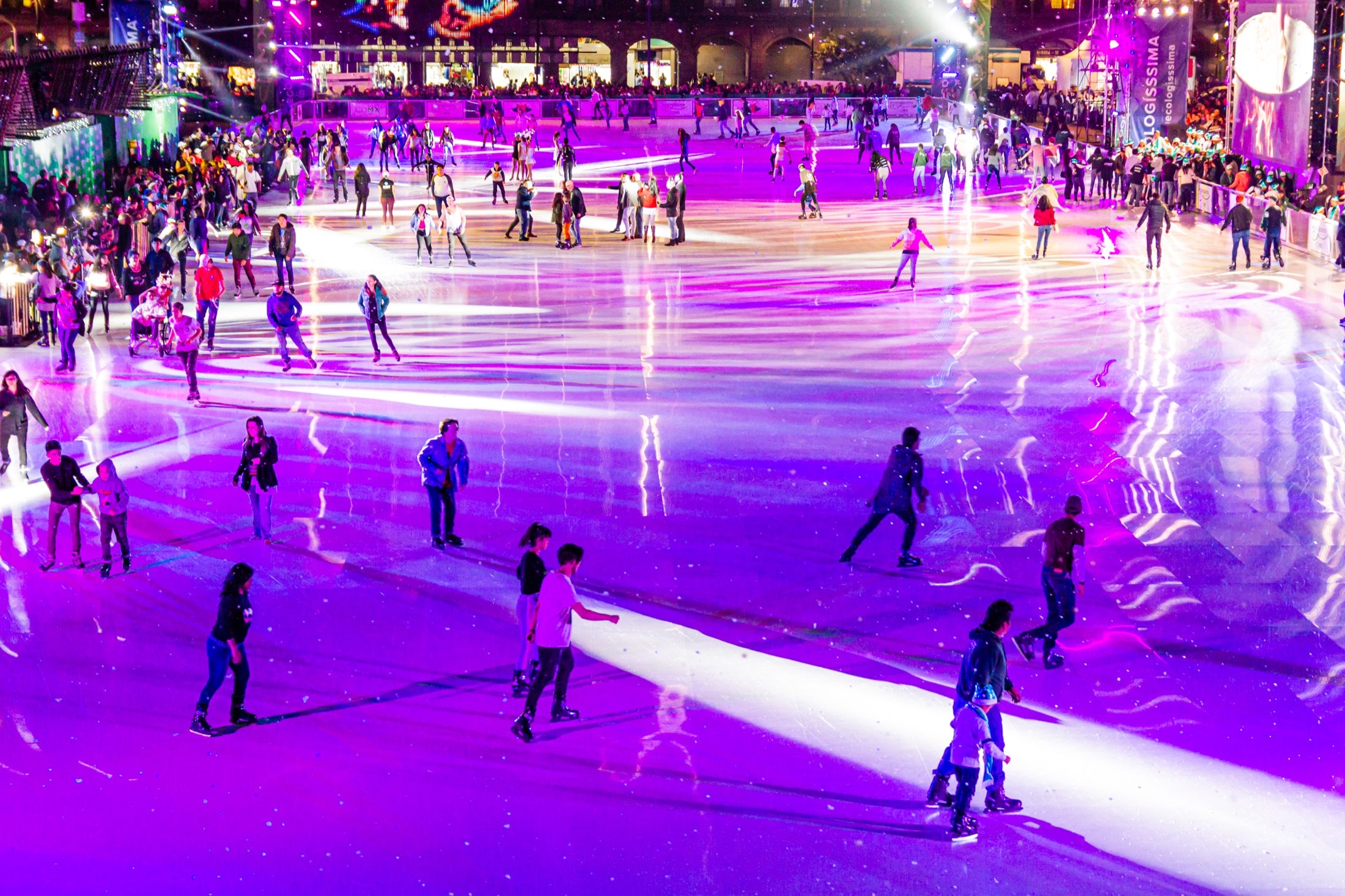
Community and public rinks are not bound by any governing body, so they come in every size. Many are built to roughly NHL proportions because the equipment and layout are familiar, but a mall, hotel or town-square rink is usually sized to its space and its expected crowd rather than to a regulation. There is no wrong size for a recreational rink; there is only the size that fits the space and fills it with people.
Backyard ice rink sizes
Home and backyard rinks are the most flexible of all. Common kit sizes start around 20 by 40 feet (6 by 12 m) and run up to 24 by 48 feet (7 by 15 m), with larger hockey setups reaching 40 feet or more in width. The right size for a backyard is set by the flat space available and by whether it is for free skating, shooting practice or small-sided hockey.
How big should your rink be?
Honestly, probably smaller than you assume. No major federation homologates synthetic ice for sanctioned competition yet, so there is no real reason to build an official-size rink unless you genuinely have the space, the budget and the demand from your members for one. That "yet" is worth noting: as the technology gains recognition, official homologation could well follow for some leagues in the near term. If a club has all three, a full NHL or IIHF surface makes sense. If it does not, a smaller surface is usually the better call, and it is where the game itself is heading: in hockey, smaller-sided formats like 3-on-3 are growing fast and run happily on a fraction of a full sheet. See the 3-on-3 hockey page.
For a recreational or commercial rink, size to two things: the flat space you have and the crowd you expect. A rink that is slightly too small sells out and feels busy; one that is too big looks empty and costs more to run. The safe approach is to start smaller than your ambition, prove the demand, and expand, which the modular nature of a synthetic rink makes straightforward. The operational side of sizing is on the Running a successful rink project page.
Why synthetic ice removes the size constraint
On refrigerated ice, the size is limited by where a cooling plant can be built. Synthetic ice has no plant, so the space sets the size, not the machinery. A synthetic rink can be built to any of the dimensions above, indoors or outdoors, in a place a refrigerated rink could never go, and because it is modular it can be enlarged later rather than rebuilt. For training, recreation and events at any of these sizes, the size is yours to choose. The full comparison is on the Synthetic ice vs refrigerated ice page.
From a single panel to the world's largest rink
Because a synthetic rink is built from modular panels, it can be almost any size or shape. Glice's commercial panels measure 1,996 by 996 mm at 20 mm thick; the same footprint at 13 mm suits smaller rinks up to about 100 m²; and for indoor home use there are 60 by 60 cm dovetail panels at 10 mm. Being modular, the rink has effectively no minimum and no maximum. At one end, some clients order a single panel, and figure skaters have bought a couple, set them up at home and practised their pirouettes on them. At the other, Glice built the world's largest synthetic ice rink, a 4,000 m² surface, more than twice the size of an Olympic sheet. Whatever you need sits somewhere between those two.
In short
Full-size ice rinks come in two main standards: NHL at 200 by 85 feet, and international or Olympic at 60 by 30 metres, with figure skating using the same 60 by 30 metre surface and curling on long, narrow sheets. Recreational and backyard rinks can be any size. On refrigerated ice the size is set by the cooling plant; on synthetic ice it is set by your space, so you can build to any of these dimensions almost anywhere and expand later, from a single Glice panel up to the 4,000 m² rink Glice built, the largest synthetic ice rink in the world.
Sources
- NHL official rink specifications; IIHF rink regulations; ISU Special Regulations (Single and Pair Skating and Ice Dance), Rule 342; World Curling sheet specifications. Standard-size figures cross-checked against multiple public references, August 2026.