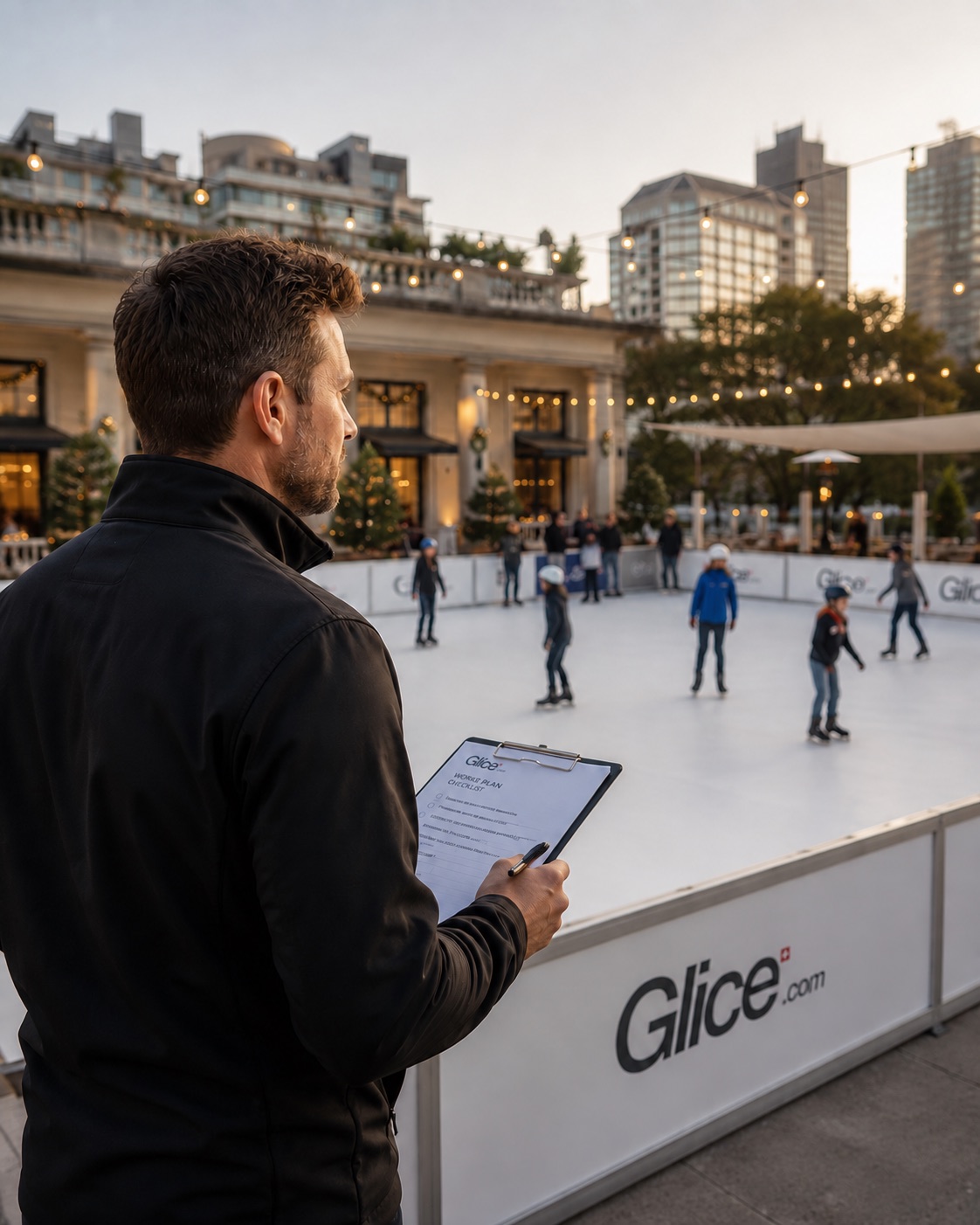
Start from the outcome, not the price
The instinct is to reduce risk by reducing price. It is the wrong instinct, because the surface is the one part of a rink you cannot fix later without replacing it. So start somewhere else. Picture the perfect outcome: imagine sitting down with your team, your investor or whoever cares about this project at the end of the season, looking back. What does a successful season look like, in detail? Then ask the opposite question, what do you want to avoid at any price? That is your benchmark. Measure every answer a supplier gives you against that perfect outcome.
The questions to ask any supplier
Ask these in order. The answers, and how willing a supplier is to give them, tell you most of what you need to know.
- What is your friction, indentation and abrasion, relative to competitors, and how was it measured? If they have no comparative measurement, ask them why. A number without conditions and a comparison is not evidence.
- Do you guarantee the additives are chemically stable and will not yellow? UV stabilisation should be standard, but yellowing is often an additive-quality problem, so ask about it directly.
- Which joint system do you use, and to which ISO standard are the panels machined? Anything commercial or outdoor needs a connection that locks both horizontally and vertically, and panels machined consistently to a defined standard are what make installation smooth. This matters doubly if you install and tear the rink down regularly.
- Will you assess our site from a photo? Whether a supplier bothers to look at your ground tells you whether they care about the result or just the sale.
- How is installation guided, and will you send a supervisor?
- Do you have a maintenance programme and staff training? Whether they take this seriously is a strong signal; if you sense they have no structured approach, that is a red flag.
- What happens when our staff change, and how are new people trained, and to what standard? Ask this straight after the last question; a supplier serious about maintenance has an answer for turnover.
- Can we speak with happy clients, visit a site, and skate it ourselves, including trying a skate for comfort?
- How do the dasher boards look, and can they adjust to uneven ground? Have them explain the mechanism, not just show you a photo.
- Do you provide a storage system for a pop-up rink? Have them explain how it works.
- Do you have a local team in our region and market, and what does support look like?
- What do we need to do to make this project a success? Check whether they talk only about the rink or go beyond it, because many things decide success. The answer reveals whether a supplier understands success at all, and one who genuinely cares that you succeed will know, and will tell you.
What good answers look like
A supplier worth choosing answers the measurement question with conditions and a comparison, not a bare number; treats maintenance and training as central, not optional; is happy to put you in front of clients and onto a rink; and talks about your success, not just their product. Evasion on any of these is itself an answer.
In short
Choosing synthetic ice is not about finding the lowest price; it is about testing whether a surface and a supplier will deliver a rink people enjoy. Ask for measured, comparative performance; probe additive stability, the joint system and maintenance; insist on references, a site visit and a test skate; and judge how seriously a supplier takes your success. The willingness to answer is as revealing as the answers.