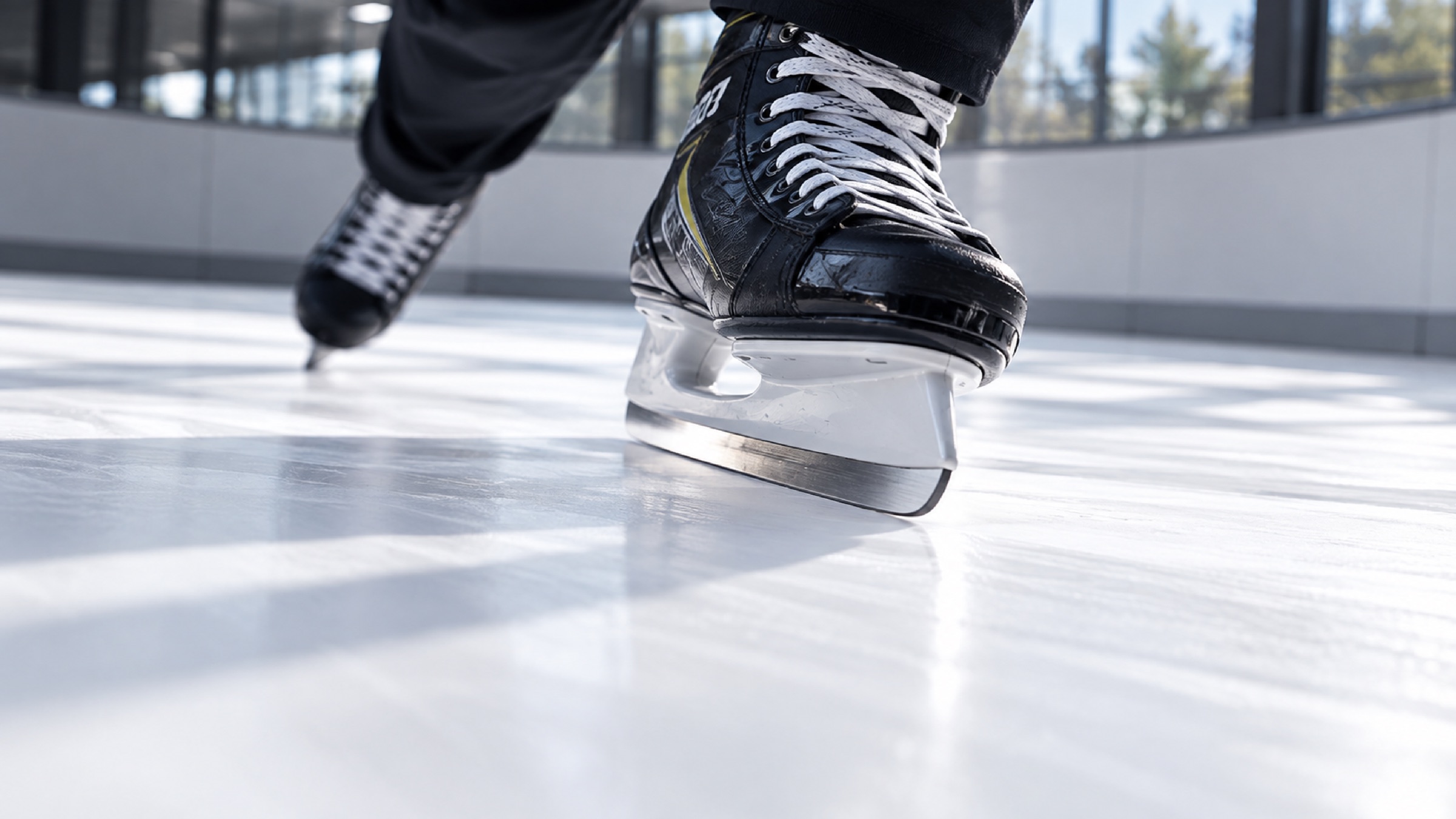
The four things every surface is judged on
Any synthetic surface comes down to four properties: surface friction, indentation, abrasion, and a flat, even surface. The first three are the real engineering; an even surface is the baseline you should expect from anyone. What each one means, and why they matter, is explained on the What is synthetic ice? page. This page is how Glice answers each of them.
Why Glice glides: a hard core and a mobile skin
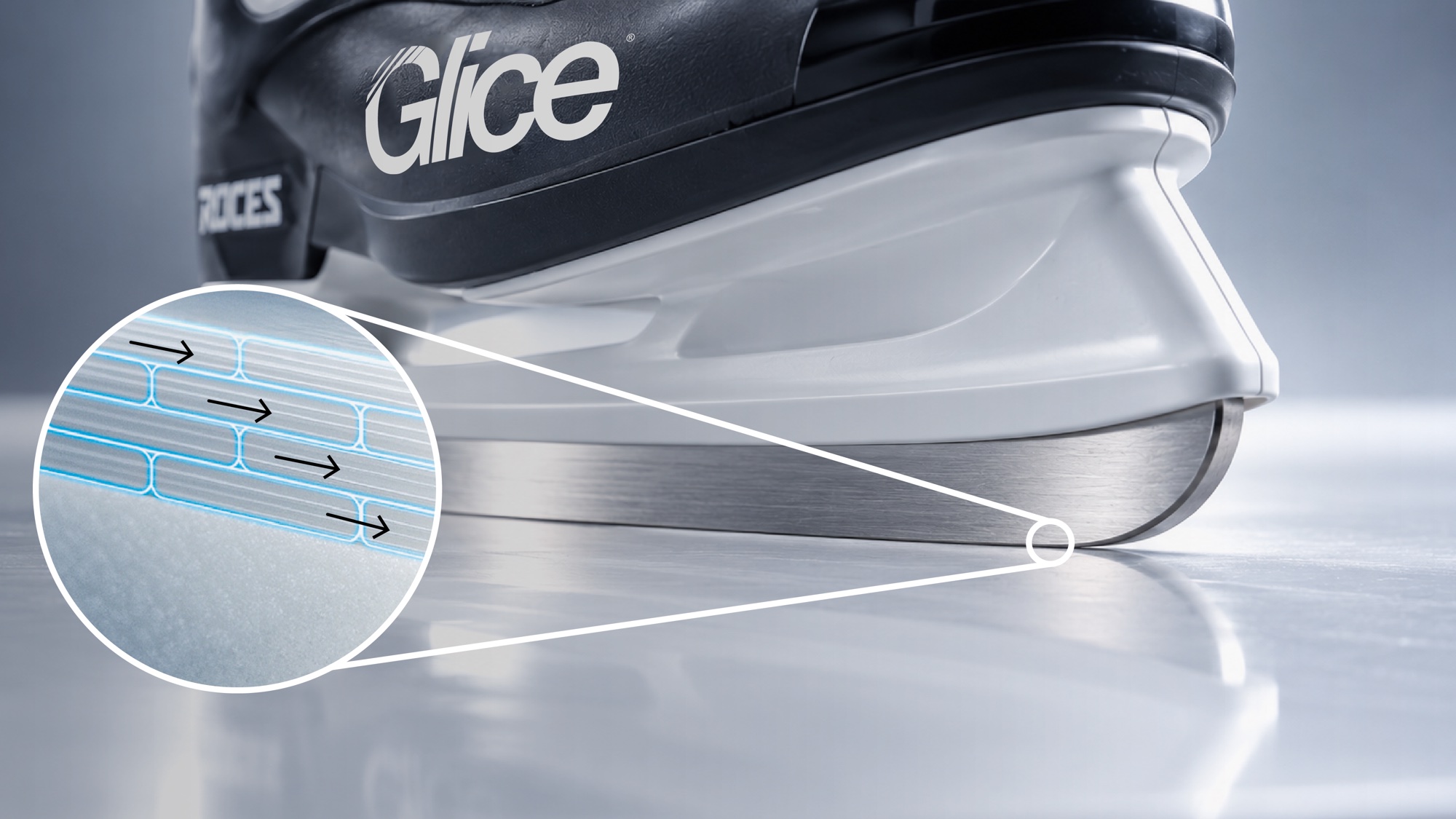
A surface has to do two opposite things at once: be hard enough that the blade does not sink in, and mobile enough at the very top that the blade slides. Glice does both with a two-part structure. Underneath is an ultra-stable polymer core that carries the load and stops the blade sinking, which keeps indentation low. On top is a thin layer whose polymer chains shear sideways under the blade, like a fanned deck of cards sliding across itself, which keeps friction low. Hard where it carries the skater, mobile where it meets the blade. This specific mechanism is Glice's, not a general property of synthetic ice.
The material and the formulation
Glice starts from a specified polyethylene grade and a purpose-built package of additives and lubricants. The base grade sets the raw material, but the formulation is where the performance is won: which lubricants and additives, in what balance, chosen and tuned over years of testing. Purity matters as much as choice, because impure additives are what cause panels to yellow and degrade, so Glice fixes a controlled source and holds it. The formulation is also engineered to keep indentation low even in warm conditions, so the glide holds up as the surface softens in the heat.
How a Glice panel is made
The way a panel is formed changes what it becomes, so process is half the result. A Glice panel is mixed to full homogeneity by a computer-controlled robotic process, so every batch is the same as the last. It is then pressed under high temperature and pressure, a route that produces a harder, more homogeneous panel than extrusion. It is cooled slowly and deliberately, because fast cooling locks internal stress into a panel that looks fine but warps in its second summer, and slow cooling is the expensive step that prevents it. The final step is precise, computer-controlled CNC cutting and finishing of the connection system, so panels meet each other exactly.
The culture that keeps it consistent
A flat surface is the basic expectation; the real science is in friction, indentation and abrasion. Even with computer-controlled machines, there is room for human error, and a culture of excellence is what turns good equipment into a consistently excellent product. That care runs through every detail: the precision of the dasher boards, the service around the rink, the choice of material, the way the skates are selected and handled. Comfortable skates are only one example, but a telling one, because even a perfect surface and the best steel blade get skated on by nobody if the skate itself is uncomfortable.
Built to be flipped
Each panel carries fine creases embedded into both sides, not just the top. That matters because a Glice panel is designed to be used on one side for years of skating and then flipped over to its second, unused side, effectively doubling its skating life. Because the creases are on both sides, the second side performs like the first. The full lifecycle, including recycling and end of life, is on the sustainability page.
Connection systems
Home and small indoor rinks use a simple dovetail joint that locks horizontally. Larger, commercial and outdoor rinks use tongue-and-groove with a pin, which locks both horizontally and vertically, so no lip can rise at a seam as the ground shifts or the panels expand and contract. It is the proven standard for anything commercial, and the deeper comparison lives on the Synthetic ice panel joints page.
Always the latest generation
Glice sells the latest launched formulation, and a new generation is not launched until it has proven itself. Weathering in particular is tested in the real world rather than only in a lab, by leaving prototypes on a roof in southern Europe under continuous sun at around 40°C (104°F) for extended periods. Rental customers can choose the newest generation or the previous one at a lower price.
What Glice does not claim
Glice matches real ice glide at slow speed. At the speeds a hockey player actually reaches, refrigerated ice is expected to have lower friction, which is an expectation from the physics rather than a measurement. It is not a replacement for a refrigerated arena, and no international sports federation has yet homologated synthetic ice for sanctioned competition. And like any surface, Glice rewards maintenance and punishes neglect. The independent evidence behind the performance claims is on the Fraunhofer measurement page.
In short
Glice combines a hard core, a mobile surface layer and controlled manufacturing to support glide and a flat skating surface. Formulation, cooling and panel connections work together. Its slow-speed glide claim has defined limits, and good maintenance remains part of the skating experience.