Sustainability at Glice
We removed the environmental cost of ice.
A traditional refrigerated rink consumes electricity, water, and refrigerants every day it operates. A Glice rink consumes none of them - verified by independent labs and industry-standard benchmarks.
Need ESG documentation for a tender? Talk to a Rink Specialist
Review how a Glice synthetic ice rink changes energy, water, refrigerant, transport, service-life, and end-of-life impacts compared with refrigerated ice, supported by published sustainability and ESG documentation.
Glice is a Swiss-engineered synthetic ice rink system that delivers a real skating experience on regular ice skates, with no water and no electricity. Its solid polymer panels showed 52% less friction than the next-best synthetic ice in standardized Fraunhofer Institute testing, and are now installed in more than 3,000 rinks across 100+ countries.
Reviewed by Viktor Meier, Co-Founder & CEO, Glice AG · Last reviewed: June 2026
What Traditional Ice Actually Costs
The hidden footprint of refrigerated ice.
Refrigerated ice is one of the most resource-intensive surfaces in modern public space. Per square meter, every year, a traditional refrigerated rink consumes up to 840 kWh of electricity, 600 liters of water, and 1.8 liters of synthetic refrigerant - emitting roughly 415 kg of CO2 in the process. The numbers scale with the rink. A medium-sized public rink emits the equivalent of dozens of cars driven year-round.
These are not Glice numbers. They are the industry's own benchmarks, sourced from ASHRAE and the Arena Guide Canada. They describe the operational reality of refrigerated ice - a reality that has shaped public skating for a century, and that is increasingly difficult to defend in a procurement process scored on environmental impact.
Zero Is the Starting Point
Glice removes the ice plant.
A Glice rink operates without refrigeration electricity at the skating surface, without rink water for resurfacing, and without refrigerants to chill. The polyethylene panels deliver a true skating experience without any of the operational infrastructure that defines refrigerated ice. The savings are not marginal - they are structural.
Per square meter of conventional ice replaced, per year
What this looks like in practice
A 200 m2 hotel rink - the kind installed for a seasonal lobby attraction or outdoor terrace - avoids 168,000 kWh of electricity and 83 tonnes of CO2 per year by choosing Glice over a conventional refrigerated surface. That is the annual energy consumption of roughly 40 European households eliminated from one amenity.
A 600 m2 city-centre rink - the type a municipality deploys in a public square for a winter season - avoids 504,000 kWh and 249 tonnes of CO2. It also removes the need for 360,000 liters of water annually, a growing concern in procurement frameworks that assess water stress.
A 1,800 m2 full-size rink - an arena-format installation used by hockey clubs, training centers, or large public venues - avoids 1,512,000 kWh, 747 tonnes of CO2, and 1,080,000 liters of water per year. The refrigerant savings alone amount to 3,240 liters of synthetic refrigerant that never needs to be produced, charged, maintained, or disposed of.
Manufacturing, Measured
Every Glice panel pays back its production footprint in three weeks.
Manufacturing a standard Glice panel (2 m2) produces approximately 30.96 kg of CO2 - or 15.48 kg per square meter. That is the total embodied carbon of the product: raw material extraction, polymerization, extrusion, finishing, and packaging. It is a real number, and we report it because transparency is the baseline, not the aspiration.
A conventional refrigerated rink surface emits approximately 415 kg of CO2 per square meter per year. A Glice panel's entire production footprint is equivalent to roughly three weeks of operation of the ice surface it replaces. After that, every day of use is a net positive.
The production energy comparison is equally stark. Manufacturing the aluminum refrigeration piping system for a conventional rink requires approximately 280 times more energy than manufacturing the equivalent area of Glice surface. This is not an approximation - it is the ratio of documented production energy per square meter for aluminum piping systems versus extrusion of polyethylene (PE) panels with a customised molecular weight.

Independently Verified
Less abrasion than the other tested surfaces. A protocol designed to contain it.
Microplastic abrasion is a legitimate concern for any polymer surface used at scale. Glice addresses it with data, not dismissal. Independent testing by the Fraunhofer Institute for Mechanics of Materials (Fraunhofer IWM) found that Glice produced 6% less abrasion than the next-best tested surface and 18% less than the weakest under identical test conditions.4
Abrasion testing conducted by Wefapress - an ISO-certified materials laboratory - measured Glice panel wear at 0.0016 grams per skater per use under DIN ISO 4649 conditions. For context, an average pair of shoe soles releases approximately 0.3 grams of microplastic per day of walking (roughly 200 times more), and car tires release approximately 3.36 grams per day of driving (roughly 2,000 times more).5
Beyond abrasion rates, Glice operates an EcoProtocol system on every rink installation. The protocol includes integrated edge-capture barriers, a maintenance resurfacing process that collects and contains shavings, and a documented disposal pathway intended to keep collected material out of the environment.6
Built for Decades, Not Seasons
A panel that lasts 20 years, used on both sides, recycled at the end.
Glice panels are engineered for a minimum 20-year service life, backed by a 12-year warranty - the longest in the synthetic ice industry. Each panel is designed to be flipped and used on both sides, effectively doubling the active skating surface area over the product's lifetime before any replacement is needed.
When panels eventually reach end of life, Glice operates a take-back and regrinding program. Used panels are collected and reground into polyethylene feedstock for suitable lower-grade applications. Pure glide-grade polymer cannot be remade into new Glice panels, so the material is downcycled rather than re-entering Glice panel production at full grade.
Panels that are retired from professional use but still functional are donated to community programs through partnerships including Habitat for Humanity, extending their useful life further and keeping material out of landfill.
(Both Sides)
Recycling
Reuse
Our Reforestation Program
Every panel we produce plants a tree.
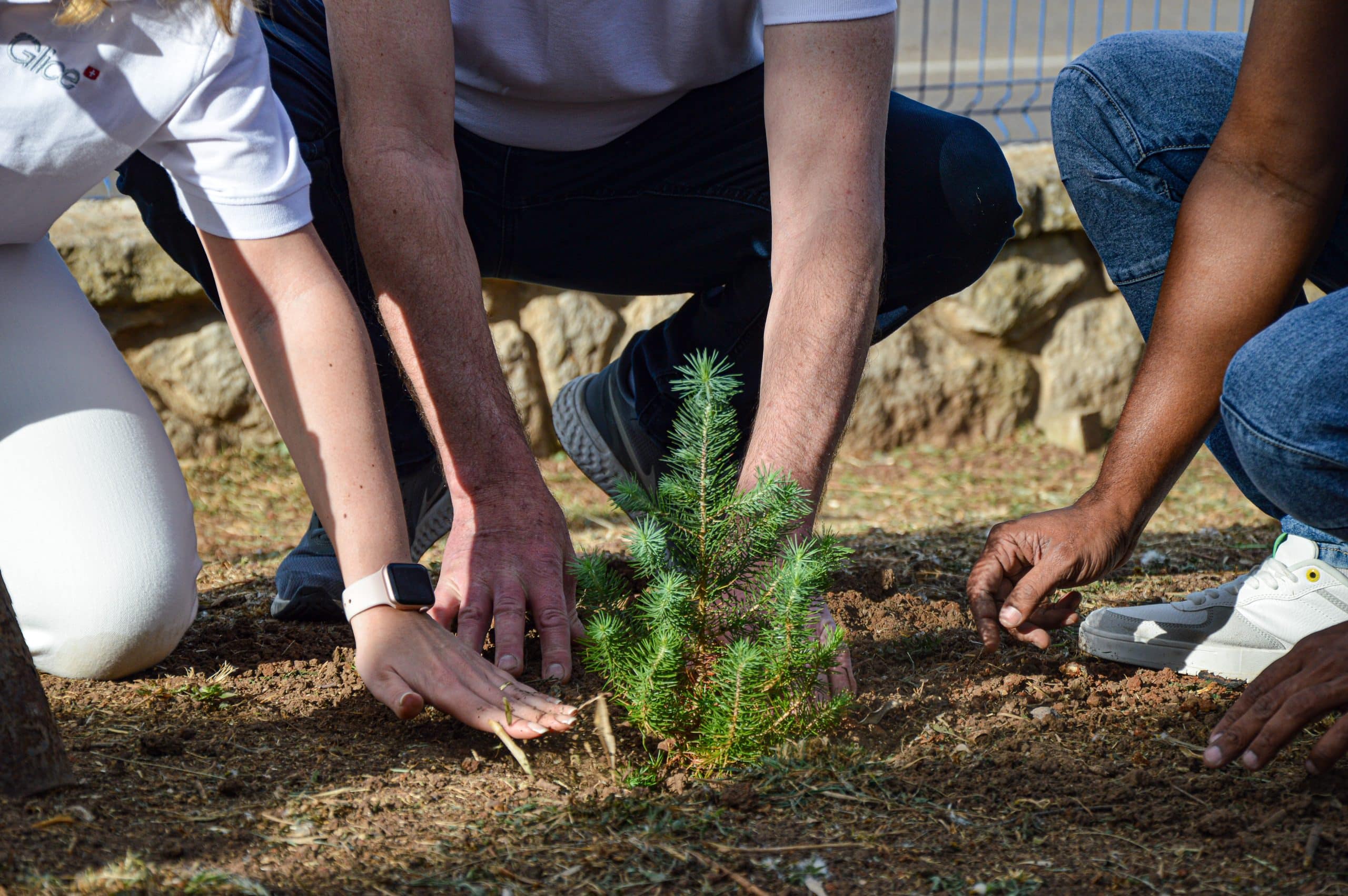
Since 2016, Glice has operated a one-panel-one-tree policy. Every synthetic ice panel manufactured triggers the planting of one tree through verified reforestation partners. To date, the program has resulted in more than 170,000 trees planted across active reforestation sites worldwide.
The program began with Plant-for-the-Planet, transitioned to Eden Reforestation Projects, and currently operates through Trees for the Future - a USDA-supported nonprofit whose Forest Garden program was named a UN World Restoration Flagship. Each tree planted is expected to absorb more than 200 kg of CO2 over its lifetime.8
Combined with the lower operating footprint of every Glice rink installed, the reforestation program helps reduce lifecycle impact. We do not buy offsets. We plant trees. And we report the numbers.

Trees for the Future - USDA-supported reforestation partner and UN World Restoration Flagship
trees planted and counting
Sustainability, Enforced
Sustainability claims need governance behind them. Ours does.
Every Glice rink installation is assigned a certified Rink Manager - a trained individual accountable for maintaining the rink to Glice's operational and environmental standards. The Rink Manager Certification is mandatory. It is not a marketing label. It is a prerequisite for warranty activation and ongoing support.
For clients who require formal environmental documentation, Glice offers the Eco-Rink Certification - an auditable package that includes lifecycle data, abrasion test results, energy offset calculations, and reforestation documentation. It is designed for municipal tenders, ESG reports, and corporate sustainability disclosures.
Named accountability matters. Every claim on this page traces back to a named person, a named institution, or a named standard. That is how we define governance: not as a policy document, but as a structure of responsibility.
Rink Manager Certification
Required for every Glice installation. Covers operational standards, maintenance protocols, and environmental compliance. Prerequisite for warranty activation and ongoing technical support.
Eco-Rink Certification
Auditable documentation package including lifecycle analysis, abrasion test results, energy offset calculations, and reforestation data. Designed for municipal tenders, ESG reports, and corporate sustainability disclosures.
Sustainability - Frequently Asked Questions
Transparency
Every claim, sourced.
The data on this page is drawn from independent testing, published industry standards, and verified operational records. We do not cite ourselves as a source for claims about our own environmental impact. Every figure is traceable, and the underlying documentation is available on request.
- 1 Electricity consumption and CO2 emissions per m2 for refrigerated ice rinks derived from ASHRAE Handbook - HVAC Applications (Chapter 44: Ice Rinks) and Arena Guide Canada operational benchmarks. CO2 conversion uses the IEA global average of 0.494 kg CO2/kWh.
- 2 Water consumption figures based on Arena Guide Canada and IIHF Facility Guidelines, accounting for resurfacing (Zamboni) cycles, dehumidification losses, and ice-plant cooling water.
- 3 Refrigerant volumes based on standard charge rates for ammonia (NH3) and HFC-based refrigeration systems as documented in ASHRAE Standard 15 and industry installation guidelines for rink-scale systems.
- 4 Fraunhofer Institute for Mechanics of Materials (Fraunhofer IWM), Freiburg, Germany. Independent comparative friction and abrasion testing of synthetic ice surfaces, commissioned by Glice AG. Full report available on request.
- 5 Wefapress abrasion testing conducted under DIN ISO 4649 conditions. Shoe sole and tire microplastic comparison data sourced from Fraunhofer UMSICHT, "Microplastics in the Environment" (2018) and OECD Workshop on Microplastics from Textile and Tyre Wear (2020).
- 6 Glice EcoProtocol documentation. Maintenance, collection, and disposal procedures are described in the Glice ESG Summary (PDF).
- 7 Scherge, M. (2023): "Nachhaltigkeit im Wintersport - Die tribologische Perspektive" (Sustainability in Winter Sports - The Tribological Perspective). Source for the municipal-sewage-treatment ultrafiltration pathway for captured polymer abrasion particles.
- 8 Trees for the Future (TREES). CO2 absorption estimate of 200+ kg per tree over lifetime based on USDA Forest Service methodologies and TREES Forest Garden Program data. UN World Restoration Flagship designation awarded by the United Nations Decade on Ecosystem Restoration.
For deeper documentation, including full test reports, lifecycle analysis methodology, and reforestation verification, contact Glice via the Rink Specialist channel or request the Glice ESG Summary (PDF).
Need ESG documentation for a tender or sustainability report?
The Glice ESG Summary (PDF) contains all data on this page, plus full lifecycle analysis, test certificates, and reforestation verification - formatted for direct inclusion in procurement documents and corporate sustainability disclosures.
Working on a tender response? Talk to a Rink Specialist
Working with Glice was different from any supplier relationship we had. They guided us through every step and made a complex project feel completely manageable.
Plan Your Rink. Get Personal Advice.
Takes 30 seconds. Get the Complete Rink Planner instantly - or add a specialist consultation for personal advice.
We've filled in your details from earlier. Just add anything extra below.
Key facts
- No refrigeration, water, or electricity required for the skating surface
- Operating in 100+ countries with 3,000+ installations
- Fraunhofer IWM validated Glice glide performance matching freshly resurfaced real ice at lower speed
- Panels manufactured in Germany under exclusivity; dasher boards and rink accessories manufactured in the EU
Last updated: June 2026