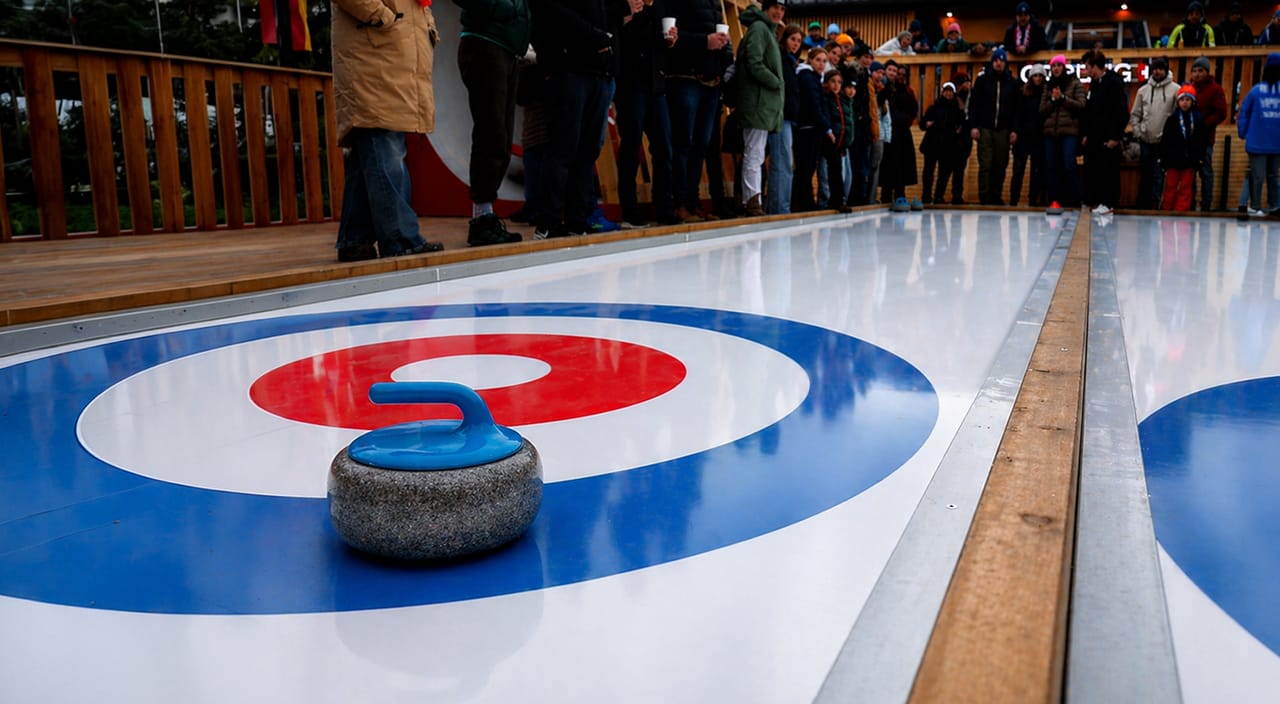
Curling looks simple from the stands — slide a stone, sweep, score — but the sheet it's played on is precisely specified by the World Curling Federation (WCF), right down to the diameter of the target rings.
Here's what those official numbers actually are, and what to think about if you're planning ice of your own.
Curling sheet dimensions at a glance
| Measurement | Official range |
|---|---|
| Sheet length | 146–150 ft (44.5–45.7 m) |
| Sheet width | 14.5–16.5 ft (4.4–5.0 m) |
| House diameter | 12 ft (3.66 m) |
| House rings | 8 ft, 4 ft, and 1 ft (the “button”) |
| Tee line to backboard | 16 ft (4.9 m) |
| Hack to hack (playing length) | ~138 ft |
A full-size ice rink can typically fit up to five curling sheets side by side, laid out lengthwise — which is why you'll often see multiple games running simultaneously in a dedicated curling arena.
Breaking down the sheet
The playing surface — called the sheet — is a long, narrow rectangle of ice, flat and level by design so a 38–44 lb granite stone travels predictably from one end to the other. At each end sits the house: the circular target made up of three concentric rings (8 ft, 4 ft, and the 1-ft “button” at the center) plus the outer 12-ft boundary, all centered where the tee line and center line cross.
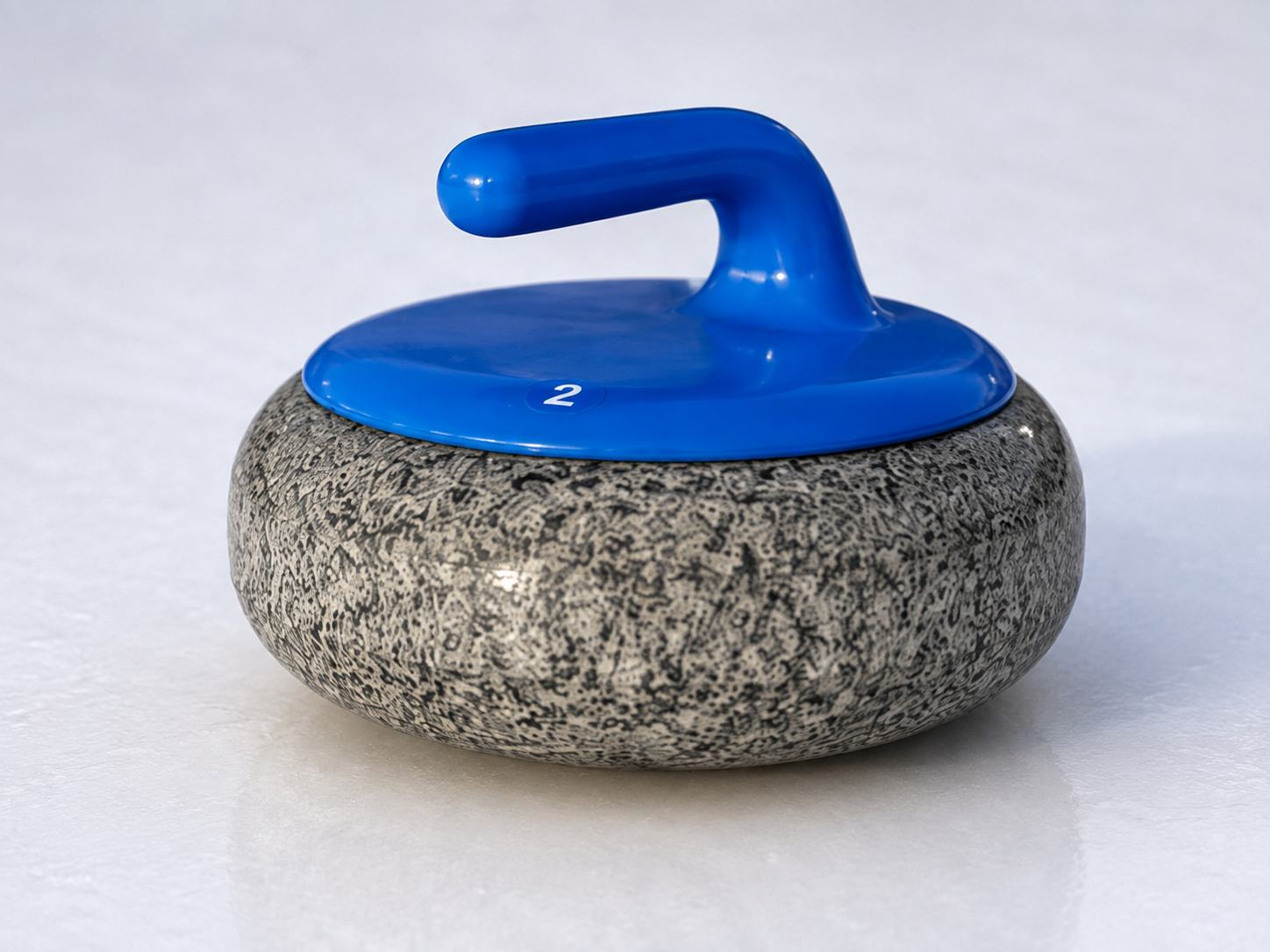
Players deliver the stone from the hack, a rubber foothold set into the ice near the backboard, and the stone must cross the hog line — roughly a third of the way down the sheet — before it's considered in play. That long, narrow shape is exactly why curling clubs are built the way they are: a curling-specific facility is really just several of these parallel sheets laid side by side.
Why the ice itself is different from hockey ice
Curling ice isn't smooth the way hockey ice is — it's deliberately pebbled, meaning the ice maker sprays a fine mist of water droplets across the surface that freeze into tiny bumps. Those bumps reduce the stone's contact with the ice, which is what lets it “curl” or drift sideways as it slides and lets sweepers control its speed and path.
It's a big part of why curling ice is typically kept colder and resurfaced differently than a hockey rink.
What this means if you're not building a competition sheet
A regulation WCF sheet is a serious commitment — roughly 150 feet of refrigerated ice at a precise width, plus the plant to keep it pebbled and cold. That's the right call for a dedicated curling club, but it's completely out of reach for most hospitality venues, event spaces, or clubs that just want to offer curling as an experience rather than host WCF-sanctioned competition.
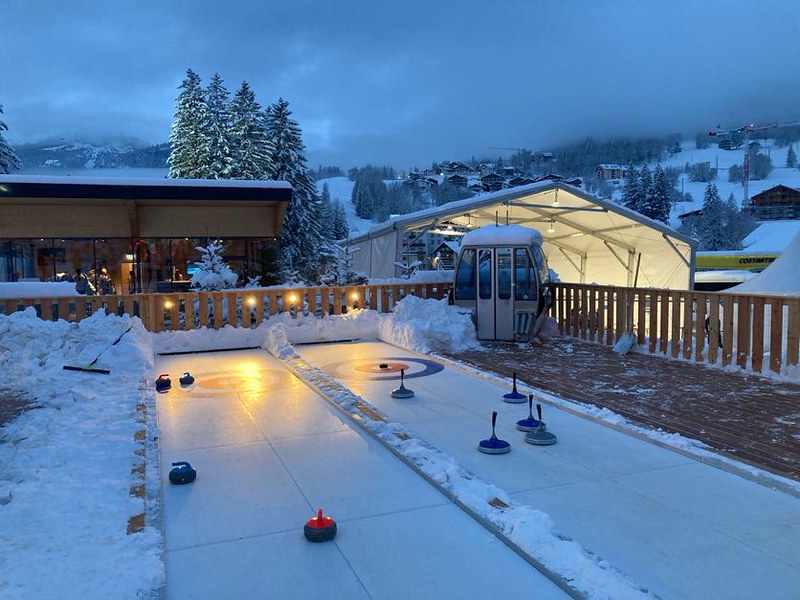
That's where synthetic curling ice changes the equation. A modular synthetic sheet can be built to accurate curling proportions — including the house, hog lines, and hack — without pouring a refrigerated slab. That means it can go into a hotel event space, a hospitality activation, or a club that wants a second or third sheet without expanding the refrigeration plant. It won't need re-pebbling between draws, and the surface is engineered to give a consistent glide without a chiller running underneath it.
On the “does it actually play like real ice” question: independent friction testing by Fraunhofer IWM found Glice's synthetic ice surface has a friction coefficient of roughly 0.035 — in Fraunhofer's words, in no way inferior to frozen water at low sliding speeds, which is the relevant speed range for a curling delivery. That's a meaningfully different claim than “feels just like ice,” and worth stating precisely rather than rounding up.
See more examples of curling with Glice.
The bottom line
- Official WCF sheet: 146–150 ft long × 14.5–16.5 ft wide
- House: 12-ft diameter with 8 ft / 4 ft / 1 ft (button) rings
- Curling ice is pebbled, not smooth, which is what makes the stone curl
- A regulation sheet needs real refrigeration and pebbling upkeep; a modular synthetic sheet gets you accurate proportions and a validated low-speed glide without either
Frequently asked questions
How big is a curling sheet?
An official curling sheet measures between 146 and 150 feet long and 14.5 to 16.5 feet wide.
What is the house in curling?
The house is the circular target at each end of a curling sheet. It has a 12-foot outer boundary and concentric 8-foot, 4-foot, and 1-foot rings.
How much does a curling stone weigh?
World Curling Federation rules specify a curling stone must weigh between 38 and 44 pounds (17 to 20 kg).
Can you play curling without a full refrigerated ice plant?
Yes. A modular synthetic curling sheet can reproduce accurate playing proportions without a refrigeration plant or ongoing ice pebbling.
Bring curling to your club, venue, or event
Create an accurate, modular curling experience without the refrigeration plant.
Explore synthetic curling rinks →