60th Ordinary ISU Congress · Tenerife, Spain · 10 to 12 June 2026
Glice at the 60th Ordinary ISU Congress 2026 in Tenerife: Invited by the ISU to address world skating.
The International Skating Union invited Glice to present to its 60th Ordinary Congress in Tenerife, and installed a Glice rink at the venue so the delegates who govern skating could judge the surface on their own blades.
Swiss engineered synthetic ice. Independently tested by Germany's Fraunhofer Institute.
Read how Glice presented synthetic ice access and independent performance evidence at the 60th Ordinary ISU Congress in Tenerife, where skating delegates could test the installed rink themselves.
Glice is a Swiss-engineered synthetic ice rink system that delivers a real skating experience on regular ice skates, with no water and no electricity. Its solid polymer panels showed 52% less friction than the next-best synthetic ice in standardized Fraunhofer Institute testing, and are now installed in more than 3,000 rinks across 100+ countries.
Reviewed by Viktor Meier, Co-Founder & CEO, Glice AG · Last reviewed: August 2026
The President of the International Skating Union

“We were delighted to welcome Glice AG to the 60th Ordinary ISU Congress in Tenerife to present its latest developments and the opportunities it offers for grassroots skating.”Jae Youl Kim, President, International Skating Union
Published 7 July 2026 and carried internationally. Source: GlobeNewswire.
A Speaking Slot, and a Rink.
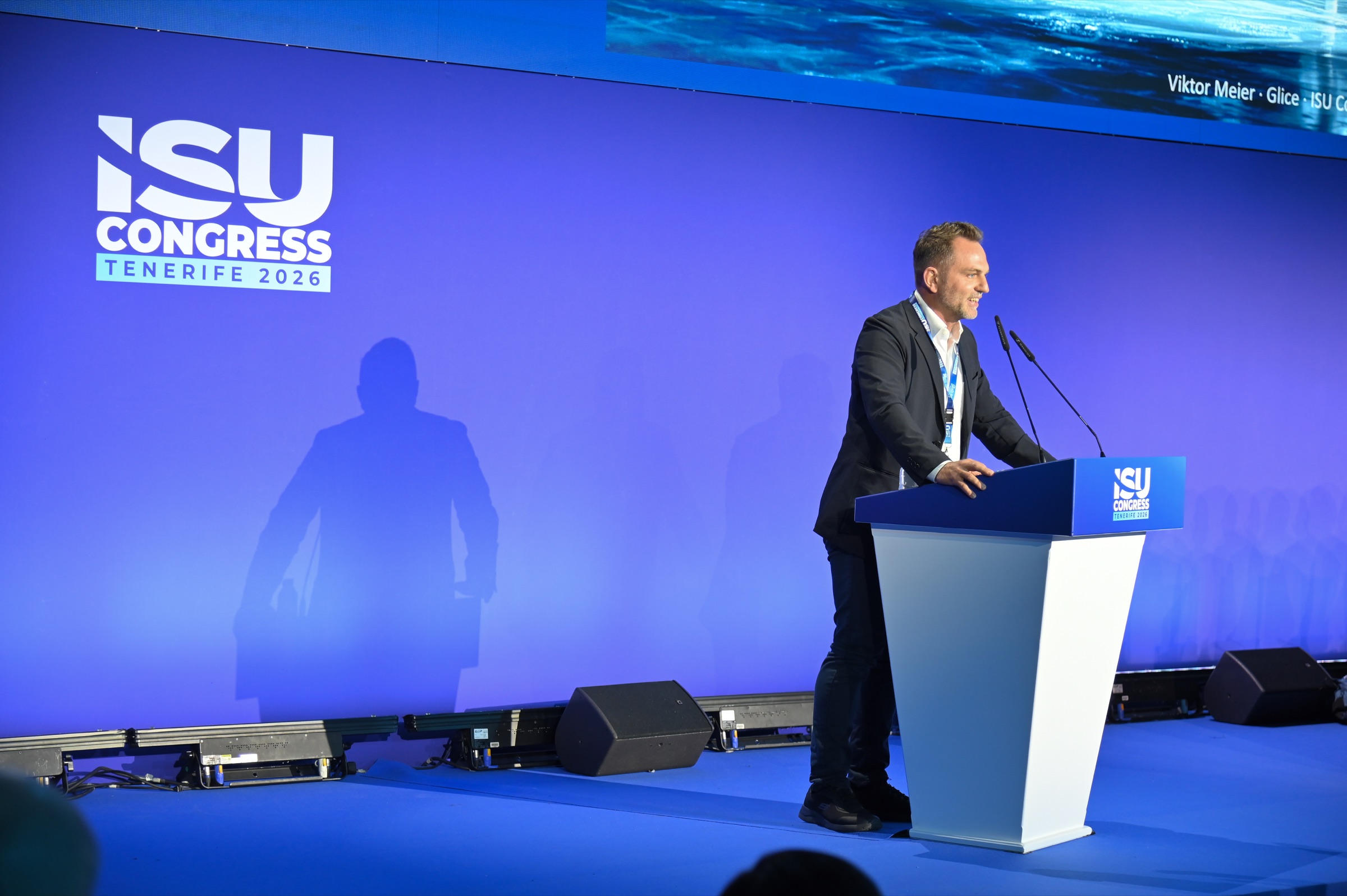
The ISU governs figure skating, synchronized skating, speed skating and short track worldwide. Its Congress is where that federation decides its own direction. For the 60th Ordinary Congress, the ISU gave Glice a place on the programme, and Viktor Meier presented to the assembled delegates on the future of ice infrastructure for skating.
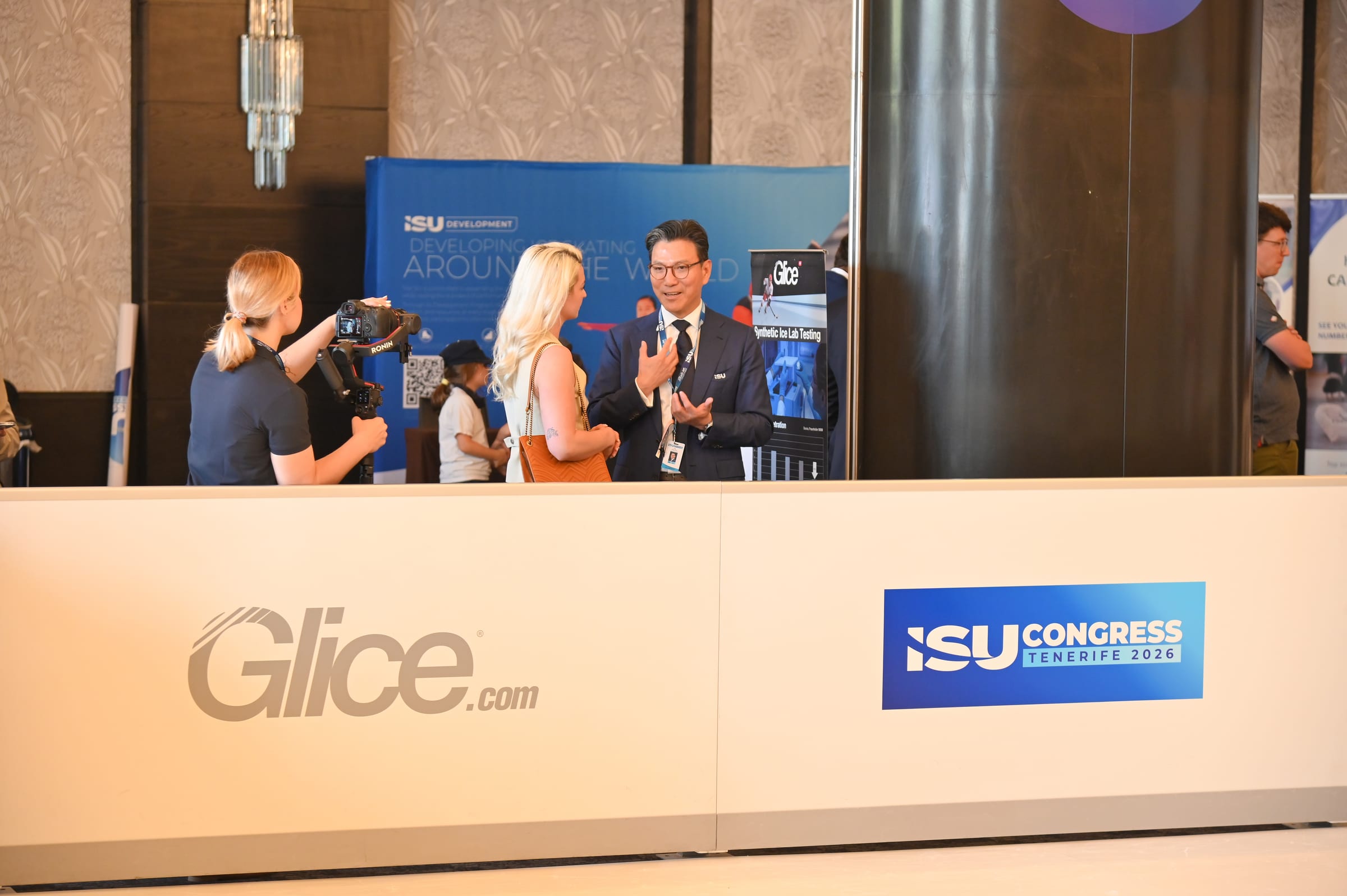
Glice also installed a rink at the venue, one floor below the Congress hall: 14 metres by 14 metres, boards branded for the Congress. Delegates were invited to put on skates between sessions and form their own opinion, which is a harder test than any slide.
In its own summary of the Congress, the ISU wrote that Glice “presented its synthetic ice technology, opening new possibilities for skating development in regions where traditional ice infrastructure remains limited.”
Opening the Glice address to the Congress
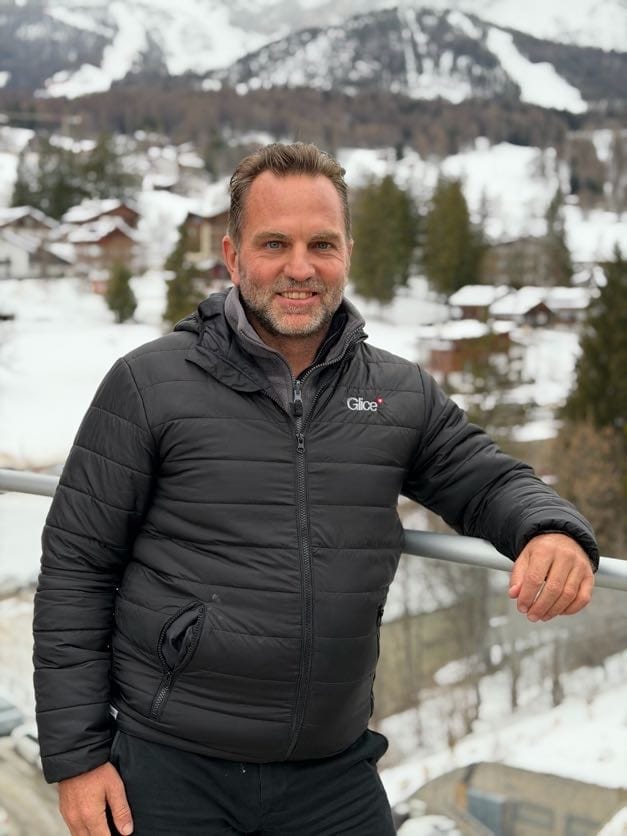
“I am really honoured to be here, and very thankful. This is an important milestone in realising my personal dream: to bring your beautiful sport of ice skating to more kids and more people around the world.”Viktor Meier, Co-Founder & CEO, Glice AG
Talent Is Not the Problem. Ice Is.
The full address to the 60th Ordinary ISU Congress, in Viktor Meier’s own words, with every word of it written out below.
Read the full transcript of the address
Transcript of the Glice address to the 60th Ordinary ISU Congress, Tenerife, delivered by Viktor Meier, Co-Founder and CEO of Glice AG. Lightly edited from the spoken delivery for readability, with automatic-caption errors corrected. The names of individual young skaters, and of one athlete who tested the surface, have been removed pending their consent.
00:25Thank you, Mr. President. Thank you, members of the ISU and the ice skating community. I am really honoured to be here, and very thankful. This is an important milestone in realising my personal dream: to bring your beautiful sport of ice skating to more kids and more people around the world.
00:51We are here to talk about synthetic ice. Synthetic ice has been around for several decades already. Some of you have tried it, and maybe you rightly say: that does not glide, it makes my blades very dull. And you rightly say, that is not an option. Or is it?
01:23I am here because I was invited by the ISU, because something has changed. That something is what I am going to talk about in this presentation.
01:37Like the previous speaker, I am not a figure skater, but I was an athlete. I did karate, and I understand the discipline it takes to reach high performance. At heart I am an entrepreneur, and I am passionate about using every means at my disposal to realise the dream I just described, because my personal concern is that your beautiful sport is under a lot of pressure.
02:12We have a crisis in Hormuz creating insecurity around energy. We have rising energy prices driven by electrification and data centres. And it is no secret that there are ice rinks closing all over the world. The rink in Ayr in Scotland, where energy prices doubled and they simply could not afford it. The rink in Prescott in Canada, where the refrigeration system failed and they could not afford to build a new one. And the rinks that do exist are under all of these pressures.
03:05If you go further: a rink is made of water, and half of the population by 2030 will be living in a water-scarce environment. That is not only countries in the global south. It is also a large part of the United States, Canada, France, and even parts of Germany.
03:38And there is a quiet victim. The talents. The young skaters who cannot train as much as their talent deserves. It is not the lack of talent. It is the lack of available ice time. That is exactly where my personal passion comes from, to find a solution.
04:02As I said, synthetic ice has not really been an option for the development of professional athletes. When I started with Glice I liked the concept of synthetic ice, because of the saving of water and energy. But I also felt the quality was not where it needs to be, because real ice is really special. It is almost magical. What is special about it is that it has a very hard core, and it has a very flexible surface, and that is what makes you glide.
04:41To achieve that we put in a lot of research and development, a lot of prototyping. We used materials such as nanoparticles used in space technology, to reach these properties of real ice.
05:02There are three big challenges with synthetic ice. Number one is that all synthetic ice is far too soft. When you skate you sink in, similar to an icebreaker boat. You sink in, and you have to push and plough through the plastic, and that makes it very resistant. So we found a way to make the material much harder, so that you do not sink in.
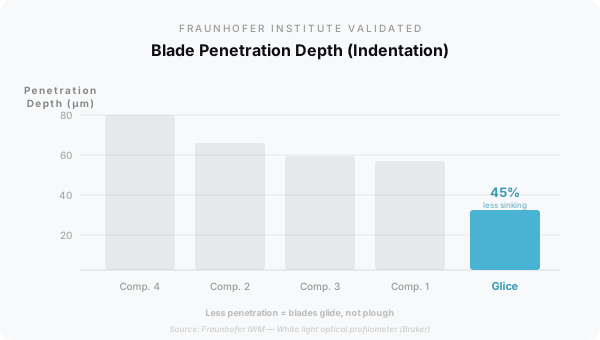
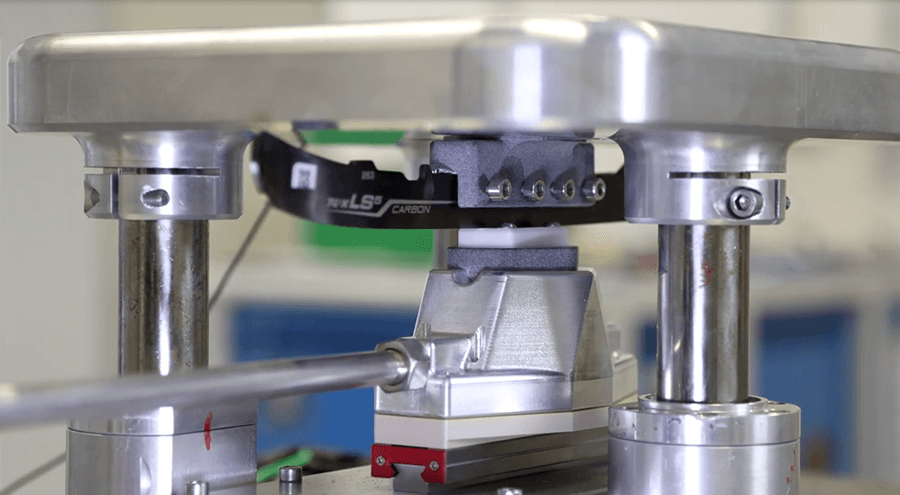
05:31We commissioned the Fraunhofer Institute, Europe's largest research institute, to test all our prototypes and see where we were getting to. Here you see a test setup: a skate that goes back and forth on top of a piece of synthetic ice, to measure indentation and friction. We were able to lower the indentation, that is the blade penetration or sinking, compared with the next best synthetic ice competitor product, by 45%. That means you sink in half as much as on the next best synthetic ice product.
06:24The second part is friction. Ice, as you know, has a very low surface friction. How did we lower ours? I will take out a deck of cards, because that is the easiest way to explain it. Everyone knows cards. What we were able to achieve is called the shear effect in physics. There are layered molecules in our product, and when a skate comes and skates on it, each molecule, or each card, multiplies the glide effect of the next. That is how we were able to replicate this low friction.
07:04And most of all, we were very, very surprised when the lab results showed that we even achieved the same friction as refrigerated ice. This was a sensation, and so the Fraunhofer Institute published a press release, and it was in hundreds of media outlets, that we achieved the same friction.
07:32However, I must say a caveat. This was made under perfect laboratory conditions, and it was under low skating speed. So if you skate very fast, the friction is still higher than what we measured in the lab.
07:53So that you understand: when you skate, the effort you put into skating is a combination of friction plus blade sinking. That is the skating effort. By lowering the friction and the blade sinking, we were able to lower the skating effort. A lot of figure skaters are very concerned about their precious skates, about the blade, that they do not want to waste it. Here it is the same. Blade dulling is a result of friction and blade penetration, and by lowering both we were able to drastically lower blade dulling.
08:38Another concern, and that is the third one. If you have experience with synthetic ice, there are little shavings, and that creates a concern about microplastics. We really took that to heart. We engineered the material so it has much less abrasion. It actually has 6% lower abrasion than the next best product. That is already an achievement, but we want to go further.
09:10Also important: we developed a cleaning process which captures 99% of the particles. We made sure that the particles are a little bit bigger than a micrometre, which means that if they are inhaled they cannot connect with biological cells, and we made them not airborne. So the health concern is taken care of. And most important, the material is not toxic. You could eat our synthetic ice and you would be perfectly fine.
09:44Okay, enough theory. I guess you want to know how it looks in practice. An ice skating club in Switzerland heard about our breakthrough. They came testing, they liked it, and they have a regular ice rink, normally an 800 square metre ice rink. They installed Glice during the summer. So during the three or four months of summer, when normally they would be on a summer break, their students can practise on the ice, and they can come back from the summer season already more advanced, and enter the new season with new skills.
10:39The feedback was very good. In just a few weeks they made improvements. They could do all the figures they want to do. And the younger coaches also appreciate the environmental aspect of it. So that is Switzerland. How does it look in other countries?
11:02In Mexico City there was a famous rink called San Jerónimo, and it was unfortunately closed, and some of the figure skating coaches there were out of a job. The other real ice rink was too far away. If you have been to Mexico, you can see the distances are really large. So they set up an ice skating club on Glice. I must also say it is an older version, it is not the breakthrough product I just presented in the statistics. They started from scratch, and now, after two or three years, they already have 115 members. What is also a good thing is that the membership fees are much lower than normal, so the kids can afford it. We got very good feedback.
11:59And what is most amazing, to use a buzzword of today: the kids who trained there are Glice native. They started on Glice, they trained and practised and prepared for competition on Glice, and they went to a real ice competition, and they won medals. [Skater names removed.] One won a silver medal and one won a gold medal.
12:39Something which is surprising is that coaches love it even more than the skaters. Why? Because Glice is a little bit less forgiving. If you make an error, if you land not correctly, you cannot mask it with a sleek recovery. Or if you do not have the perfect edge, it shows errors. And errors can be corrected, and like that you advance much faster.
13:11Another phenomenon we have seen is that more and more skaters who experience the ice rink in these centres buy an ice rink to train at home. Maybe you have read the book by Malcolm Gladwell: you need 10,000 hours of any skill to master it. So this could be your apartment from next week on.
13:56We also have something for the speed skaters. A multiple gold medallist happened to live nearby where we set up an ice rink, and he came testing, and he liked it. So that is something we have to explore. Please, if you are passionate about building the next speed skating track, come to me. [Athlete name removed.]
14:30Okay, enough talk about technology. I think what is also important is the investment. How does the investment in a Glice rink compare with real ice? There are different ways to measure it. Is it the rink itself, is it the dehumidification system, and so on. Depending on how you look at it, it can be half to 10% of a real ice rink investment. So it is huge. You can build ten rinks instead of one.
14:56What is more mind-blowing, obviously, is the electricity bill, which goes almost to zero. And we talked about water scarcity. A regular ice rink needs between half a million and 1.5 million litres of water every year. Here we get to zero. We just need some water for daily cleaning.
15:27Something a lot of people do not think about: if you want to start a skating academy and you have a little space, a warehouse, and you put in a real ice rink, you need to think about all the space for the chillers, for the ice handling, for the Zamboni garage. With Glice, all this space, which can be up to 40% if it is a small rink, can be used for practice. So that is another advantage.
15:54And no more waiting for the Zamboni, the 20 minutes where you have to be off the rink. If you count it all together, in a rink which operates from 6am to 10pm, that could easily be 3 hours of additional training.
16:12And last but not least, after an hour or 90 minutes the ice gets slushy before the Zamboni comes, and you have to avoid some lumps. With Glice you always have the same consistency of the ice. So in summary, from an economic point of view, you save on cost, you save on time, and you save on space.
16:40And there are more advantages we can talk about personally later. But having said that, I am not here to tell you: hey, let us do the next Olympics on Glice. On the contrary. Even though I am the entrepreneur behind Glice, there is something magic about real ice. It is natural. I love it. So the goal is that Glice never replaces ice for the big competitions. We only see it as complementary.
17:14If you have an ice rink and you see you want to have more ice time, you want to have more students, whatever, you can have Glice. In the hockey scene we do that much more already. It is almost normal to plan a regular ice rink with a hockey training centre on Glice next door. Or, as we have just seen, instead of closing a rink, why not have it as a replacement, or somewhere where climatically or budget-wise it is not possible.
17:49And last but not least, although we had this huge success and breakthrough in technology, we are not here to claim that it is 100% identical to real ice. But to give you some context: lately a figure skater who skated on Glice told me, it is a bit like buying a new car. When you buy a new car, the gears and everything feel a bit different. And when you drive around, after 20 minutes, 30 minutes, it feels like you always drove that car. Here it is the same. You just need some adaptation and you get used to it.
18:36And most important, and that is my goal today: I think you learned a lot today, so you need to shake out your legs a bit. So please, I ask you to come downstairs. Right below this room we set up a Glice rink. If you have your own skates, bring them, otherwise we have rental skates. It is very important, as I said, to put them on and let them warm up a bit, so that they glide better after a few minutes when the blade is warm. And just get used to it, like my friend with the deck of cards example. Let us see. Judge it for yourself. Okay, thank you so much.
What Is the ISU Congress?
Every two years, the people who run skating in their own countries meet to decide where the sport goes next.
Who is in the room
Delegates from the ISU Member Federations, together with Council Members and Office Holders. These are the national federations that run skating in their own countries, and their presidents and delegates attend in person.
What it decides
The Congress reviews the growth of the sport, sets strategic priorities, takes governance decisions and elects the ISU leadership, including the President, Vice Presidents and Council. In Tenerife it re-elected Jae Youl Kim as President for a second term.
Why it matters here
Nothing reaches this programme casually. A technology presented to the Congress is presented to the entire governing structure of world skating at once, in the same room, on the same day.
The 2026 Congress also opened the next phase of Vision 2030, the ISU strategic framework for growing participation in skating worldwide. Access to ice is the constraint that framework keeps running into, which is why the surface Glice brought to Tenerife was on the agenda at all.
Why the ISU Took Note.
Not a claim from a supplier. A measurement from Europe’s largest applied research organisation.
Viktor Meier put the objection to the delegates before he answered it: Some of you have tried synthetic ice, and you rightly said that it does not glide, that it makes your blades dull, and that it is not an option. Or is it?
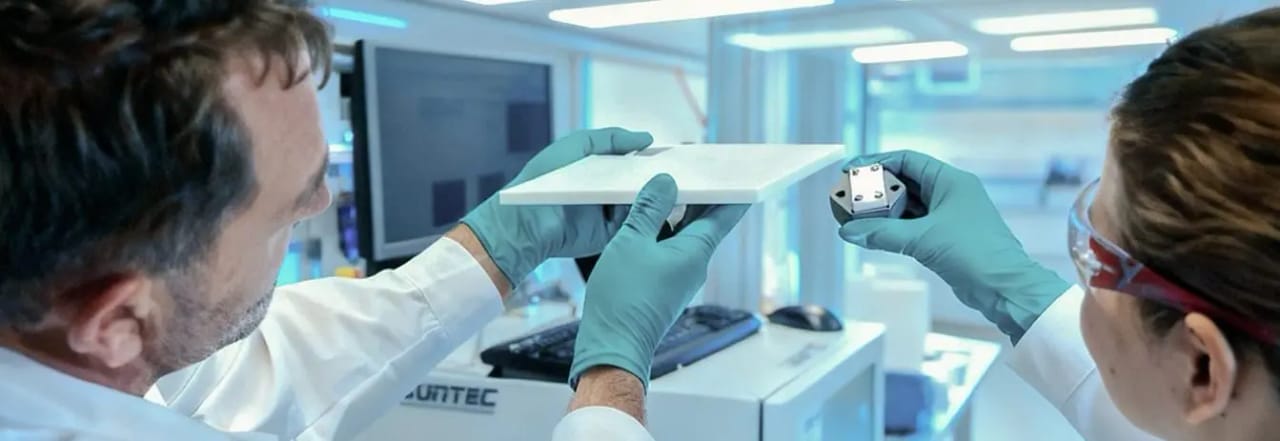
Synthetic ice has existed for decades, and for most of that time the dismissal was earned. It was too soft, so the blade sank in and had to plough through plastic. Its surface friction was too high, so it did not glide, and it dulled blades. Glice set out to fix both properties and then had the result measured by someone else: the Fraunhofer Institute for Mechanics of Materials IWM in Freiburg.
The laboratory found that the surface reached a friction coefficient equivalent to refrigerated ice under its test conditions. Fraunhofer published that finding, and it was reported around the world. That result is what put Glice in front of a federation rather than a rink operator.
Measured against real ice, and against the competition
Two separate comparisons matter, and they are easy to confuse. Against refrigerated ice, Fraunhofer testing found that the Glice surface reaches a friction coefficient equivalent to real ice. Against other synthetic ice, the same laboratory measured 52% less friction than the next-best synthetic ice.
Glice states the limit of that result rather than hiding it. Viktor Meier gave the delegates the caveat himself: I must say a caveat. This was measured under perfect laboratory conditions and at low speed. If you skate very fast, the friction is still higher than what we measured in the lab.
Blade penetration is the second factor. The deeper a blade sinks, the more material it pushes ahead of itself, like an icebreaker. Measured with a white light optical profilometer, Glice showed 45% less blade sinking than the next best competitor. Skating effort is the sum of friction and sinking, and blade dulling follows the same two terms, so lowering both lowers the effort and keeps edges sharper.
Source: Fraunhofer IWM, Zwischenbericht V1184-2025.
Inside the Breakthrough.
Reproducing ice took materials science, not a better panel.
Real ice is almost magical. It has a very hard core and a very flexible surface, and that is what makes you glide.
Viktor Meier, describing the target to the 60th Ordinary ISU Congress.
A harder core
Every other synthetic ice is far too soft, so the blade sinks in and has to push plastic ahead of it. Glice uses a much harder material, developed with nanoparticles of the kind used in space technology, so the blade rides on the surface instead of ploughing through it.
A deck of cards
Low friction comes from the shear effect. The material carries layered molecules that slide over one another like the cards in a deck, each layer multiplying the glide of the next. That is how the surface reaches a friction coefficient measured as equivalent to refrigerated ice.
Sharper edges for longer
Blade dulling is a product of friction and blade penetration. Because both were lowered, dulling falls with them. For a figure skater whose blades are a serious investment, that is not a detail.
Shavings, microplastics and safety
Anyone who has skated on older synthetic ice has seen the shavings it leaves, and the microplastic question that follows is a fair one. Glice engineered the material down to 6% less abrasion than the next best product, the lowest shavings output measured in the category, and treats that as a floor rather than a finish line.
Alongside the material, Glice developed a cleaning process that captures 99% of the particles the surface releases. The particles themselves are engineered larger than one micrometre and are not airborne, so they cannot be inhaled into biological cells. As Viktor Meier told the delegates: The material is not toxic. You could eat our synthetic ice and you would be perfectly fine.
These are the questions a federation asks before it puts a technology in front of children, and they were answered on the Congress floor rather than afterwards.
Who tested it
- Fraunhofer-Gesellschaft, Europe's largest applied research organisation, with 76 institutes and over 32,000 researchers
- Testing at the Fraunhofer Institute for Mechanics of Materials IWM in Freiburg
- Specialists in tribology, surface science and material characterisation
How it was tested
- Skate blade fixed in a tribometer, synthetic ice panels moving beneath it as counterbodies
- Friction measured directly on the blade, normal force 300 N
- 10 Hz frequency, 12 mm amplitude, 200 cycles over 20 seconds
- Blade cleaned with acetone and isopropanol before and after each run, refitted in the same position
Then They Sent Skaters.
A laboratory number is not a skating experience, and a federation knows the difference. So the ISU had professional figure skaters test the surface for themselves rather than take the data on trust.
Two of them were Olympic ice dancers: Kaitlyn Weaver, a two-time Olympian and three-time World medallist, and Evan Bates, a two-time Olympic champion and three-time World champion. They skated the rink in Tenerife in front of the delegates. Their verdicts are below, in their own words.
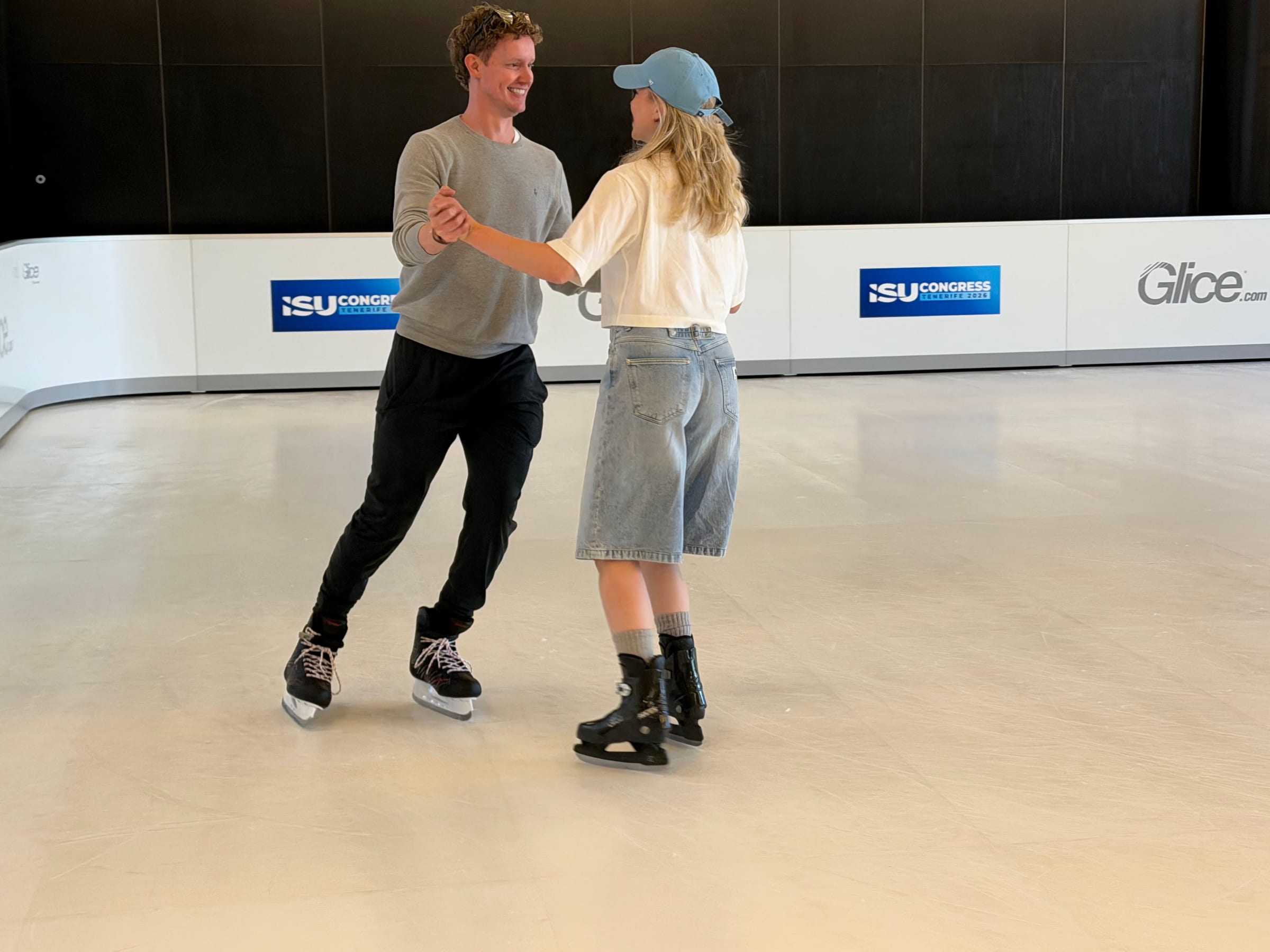

“Glice was incredibly fun to experience, I was surprised by how quickly I adapted to it and how accessible it makes skating.”Kaitlyn Weaver, two-time Olympian and three-time World medallist in ice dance
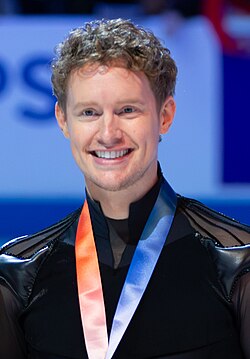
“It’s especially intuitive for beginners and I would highly recommend it to anyone looking to get into the sport.”Evan Bates, two-time Olympic champion and three-time World champion in ice dance
What Glice Presented to the Congress.
Ice rinks are closing. Energy prices, ageing refrigeration plants and water scarcity are all pressing on the same buildings, and the cost is paid by skaters who cannot get on the ice often enough to develop.
So the presentation did not stay theoretical. It showed what skaters and coaches have already done on the surface.
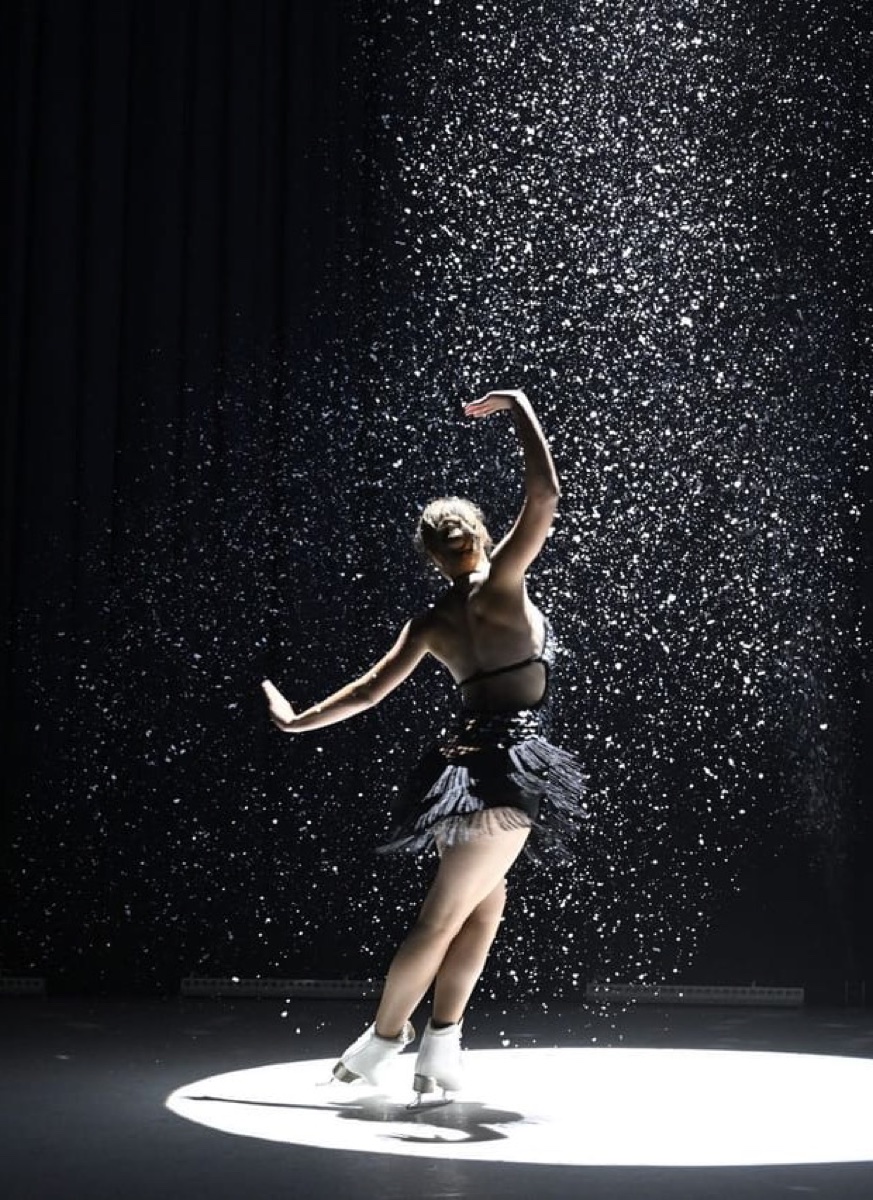
The quiet victims are the young skaters who cannot train as much as their talent deserves. It is not the lack of talent. It is the lack of available ice time.
Viktor Meier, addressing the 60th Ordinary ISU Congress.
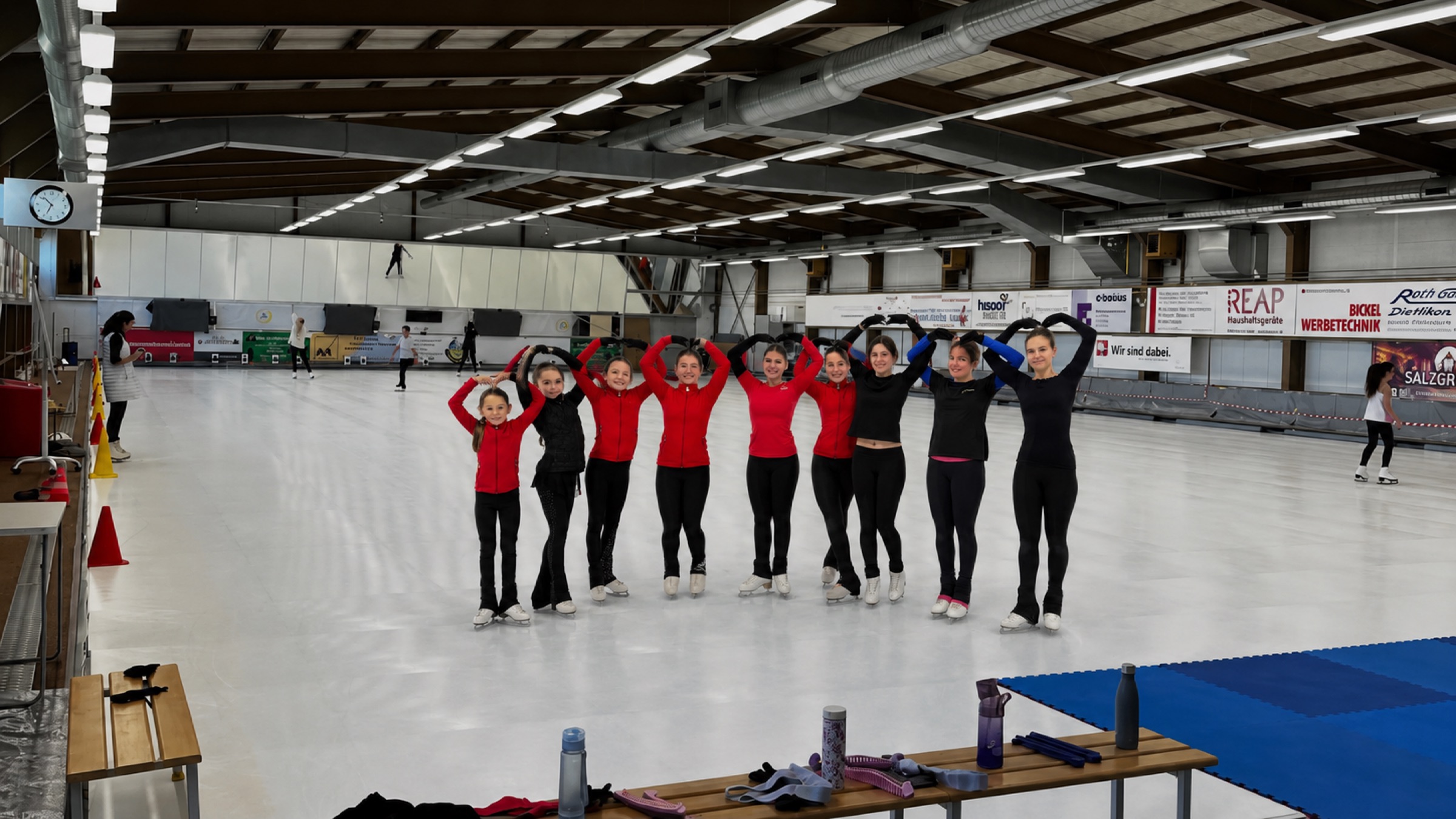
A Swiss club that skated through summer
Figure Skating Club Wallisellen heard about the Fraunhofer result, came to test the surface, and installed Glice over its 800 m² rink for the summer months. Instead of a three to four month break, its skaters kept training, and came back to the new season further ahead than they left it. The younger coaches valued the environmental side of it too.
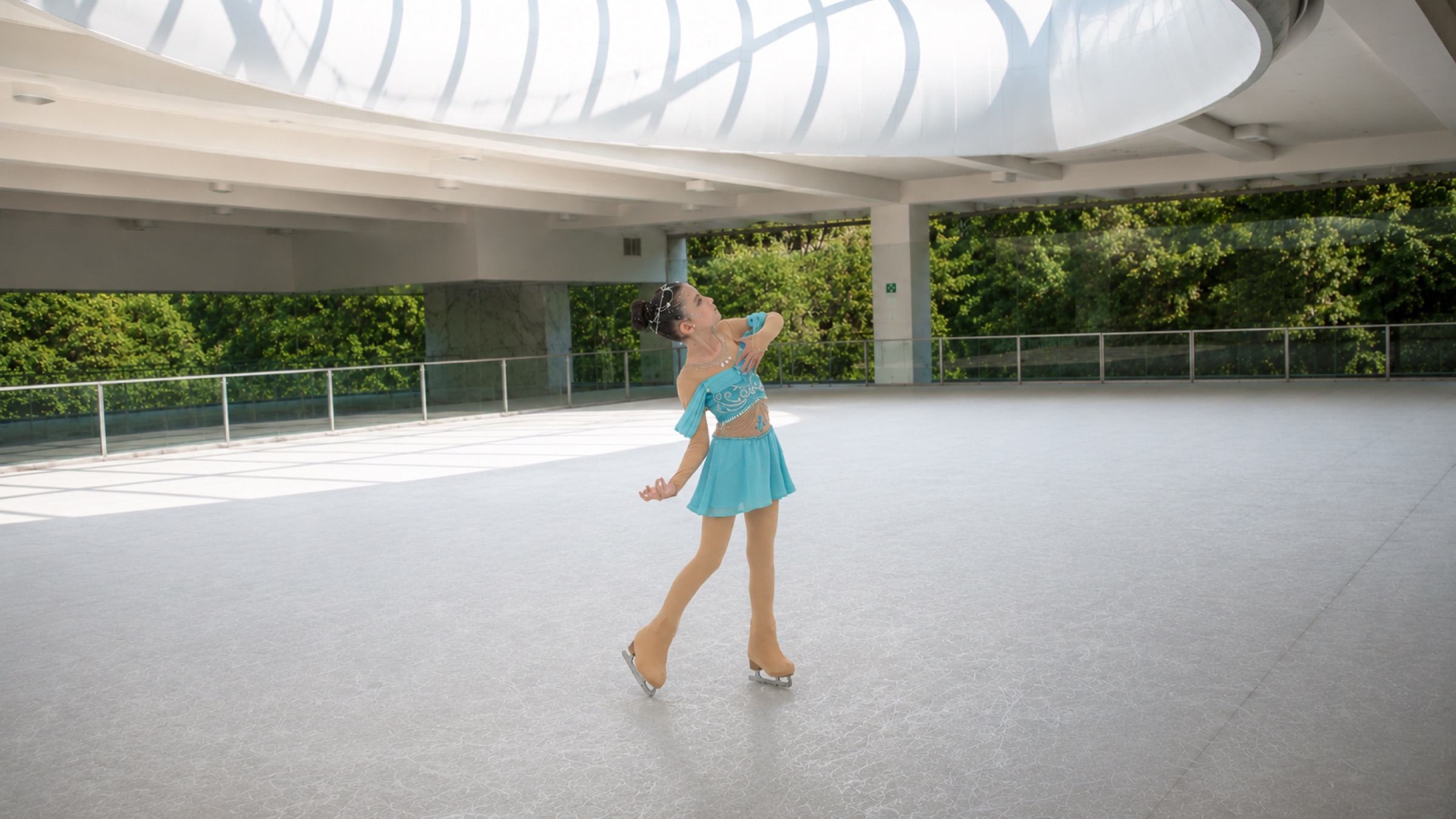
A club that started from nothing
In Mexico City, the San Jerónimo rink closed and its coaches were left without ice, with the nearest refrigerated rink an impractical distance away. They built Ice Skating Club Centro Asturiano on Glice instead, on an earlier generation of the surface. Two to three years on it has around 115 members, at membership fees low enough that families can afford them.
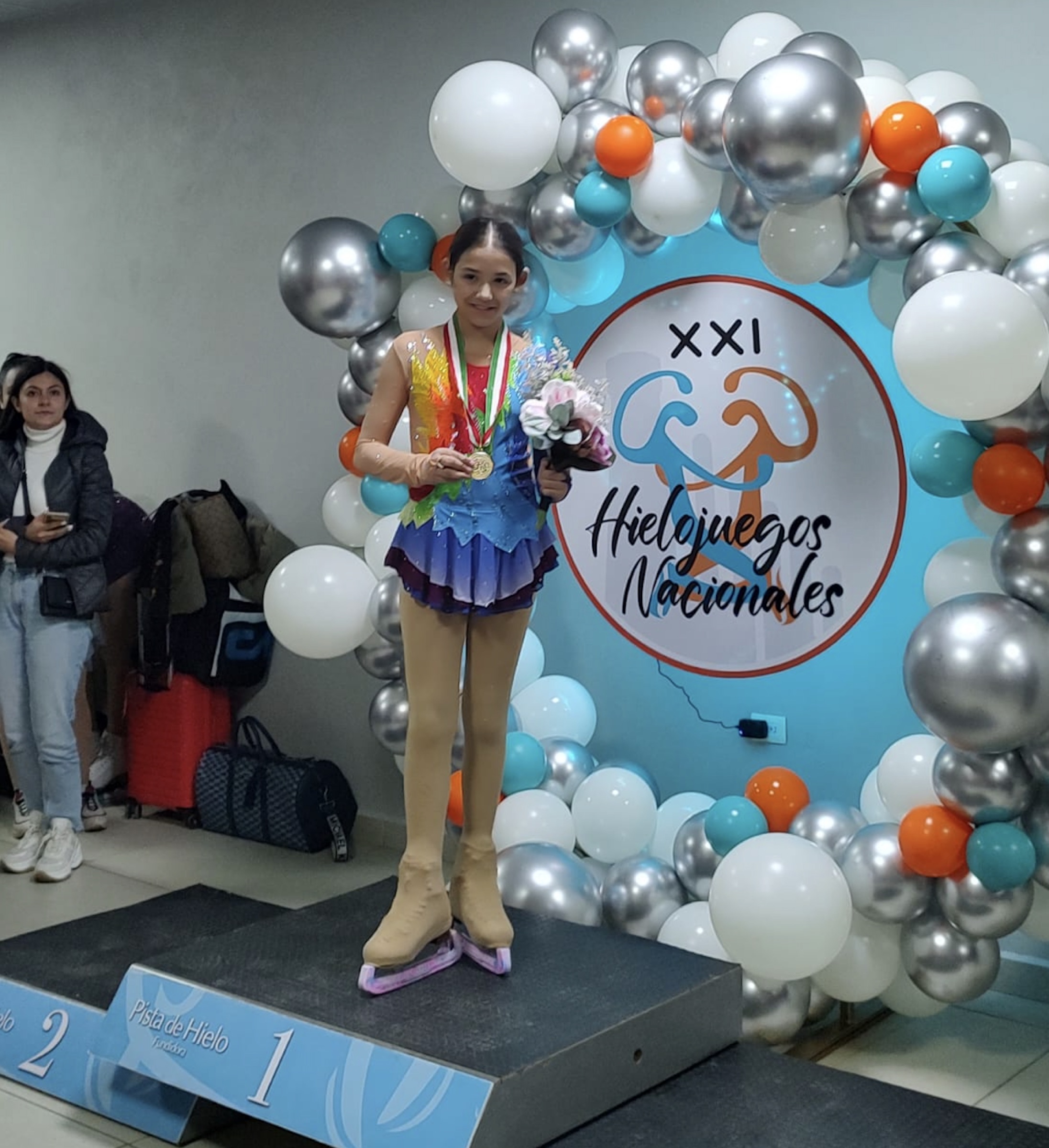
Trained on Glice, medalled on ice
Viktor Meier calls those skaters Glice native
: they started on Glice, prepared for competition on Glice, then competed on refrigerated ice and won medals, including a gold and a silver. The transfer works in the direction that matters.
Why coaches tend to like it even more than skaters
Glice is slightly less forgiving than refrigerated ice. A landing that is not quite right cannot be masked with a sleek recovery, and an imperfect edge shows itself. Errors that show can be corrected, and skaters who correct them advance faster.
Adaptation is real but short. One figure skater compared it to a new car: the gears feel unfamiliar for twenty or thirty minutes, and then it feels like the car you have always driven.
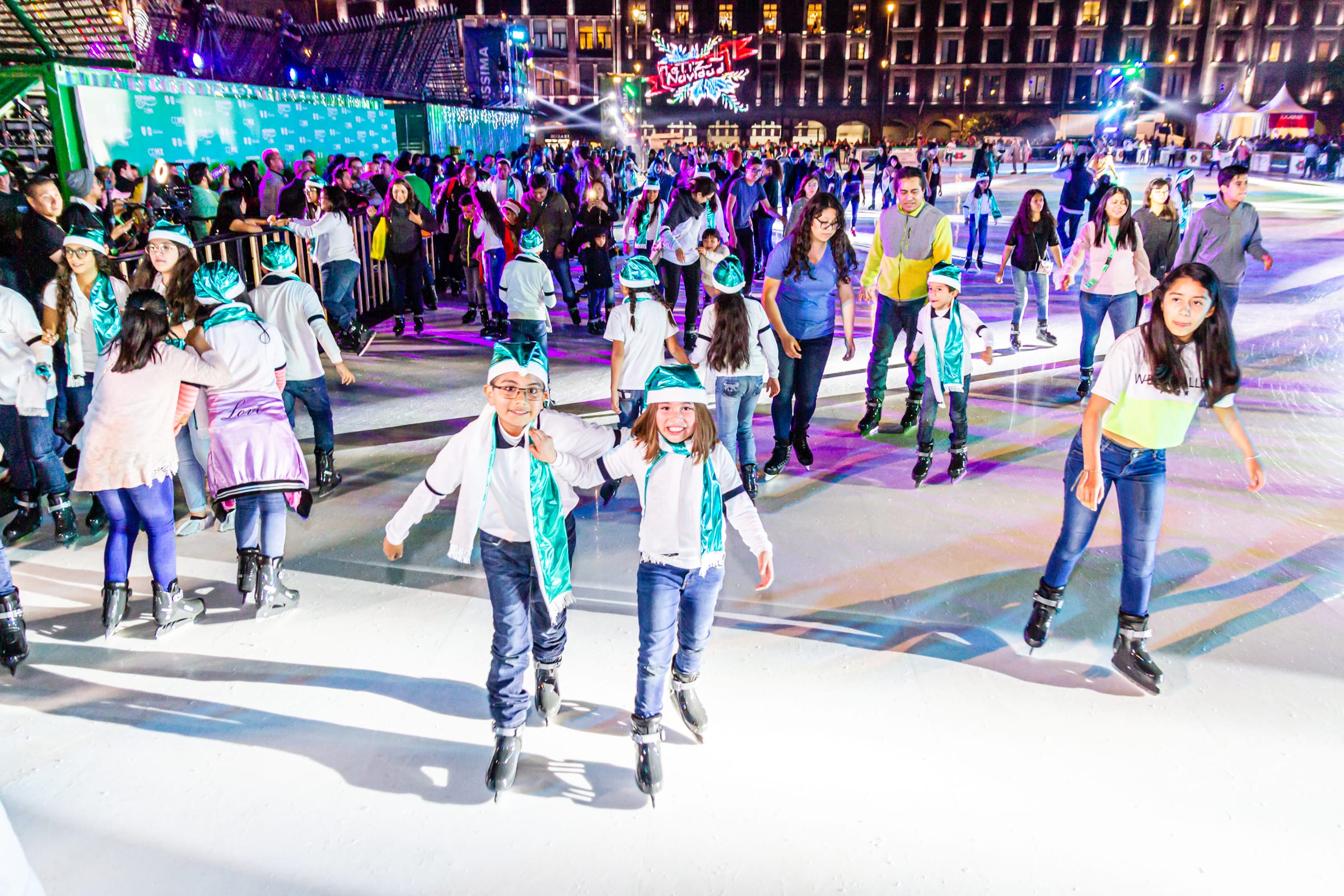
The Economics of a Second Sheet.
For a federation trying to grow participation, the question is not whether refrigerated ice is better. It is how many sheets exist at all.
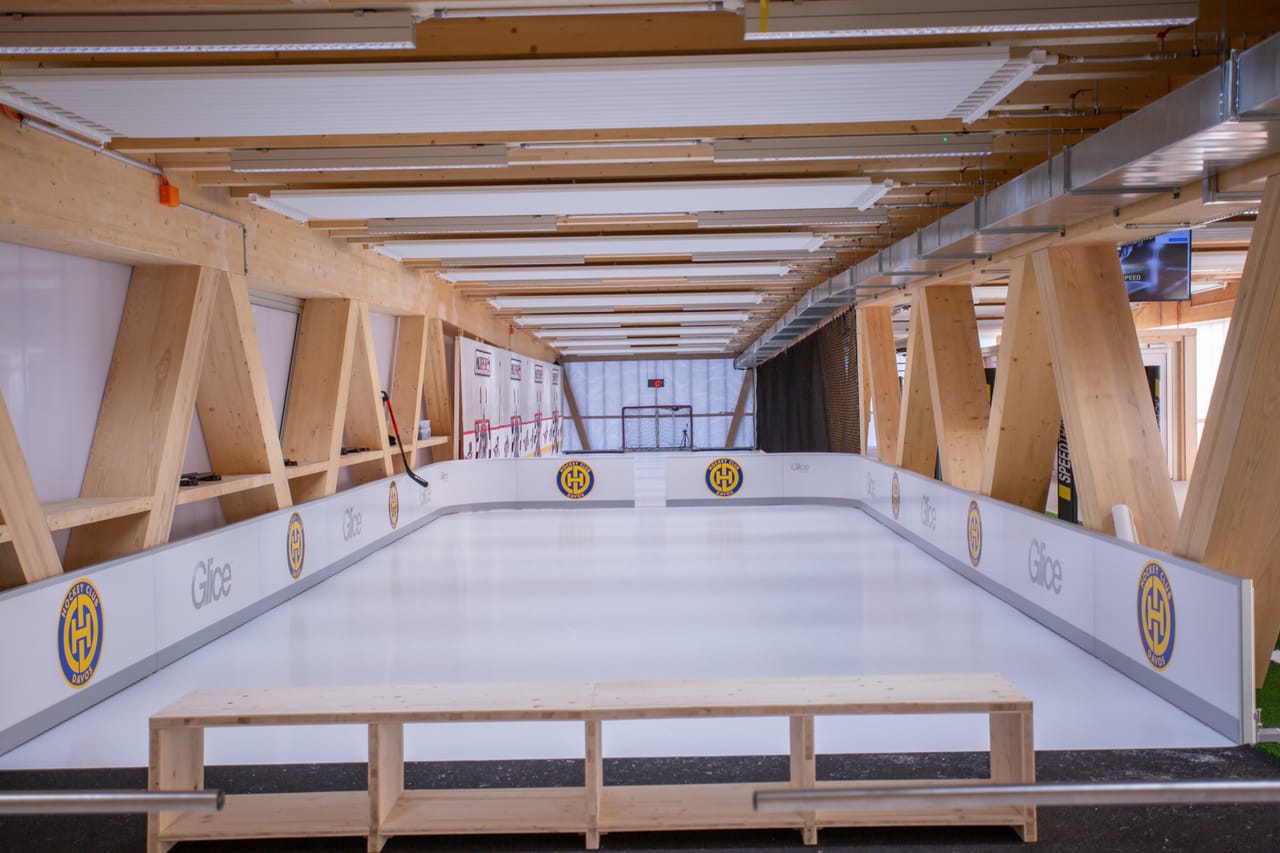
Investment
Depending on what is counted, a Glice rink costs a fraction of a refrigerated rink, since there is no chiller plant, no dehumidification and no ice handling infrastructure to build. The same budget can open several sheets instead of one.
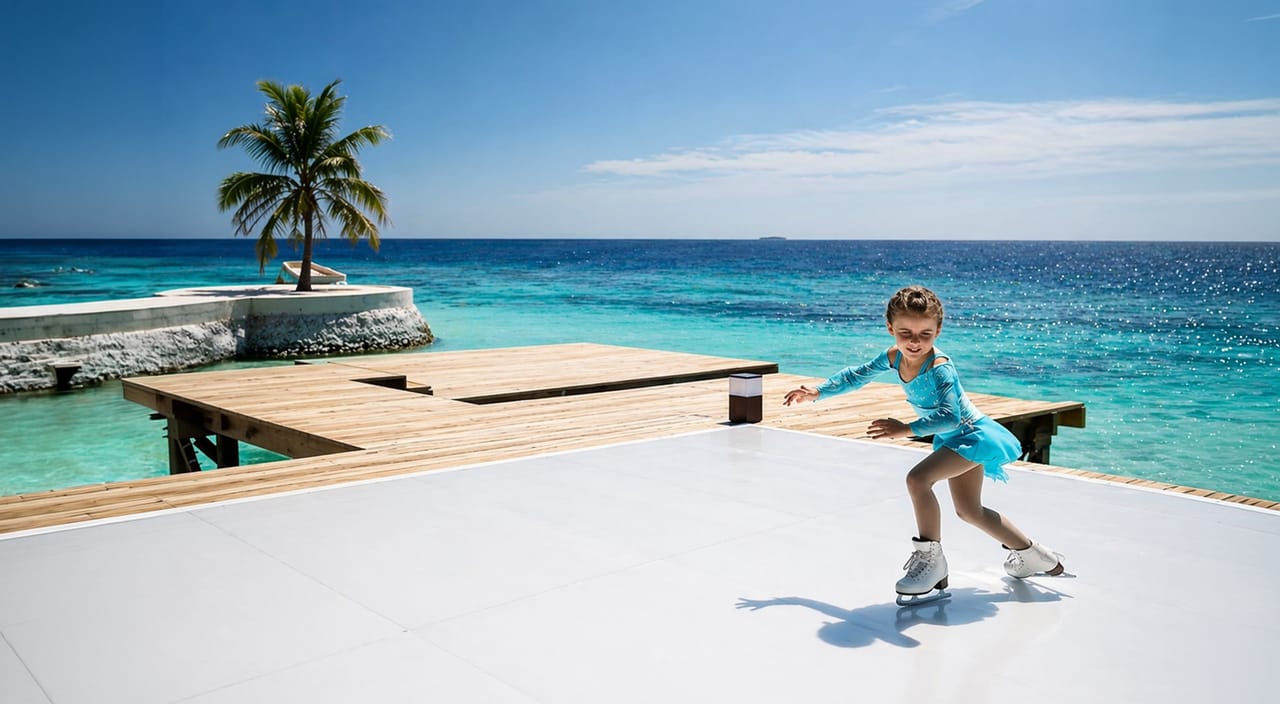
Electricity and water
The electricity bill for the skating surface goes to almost nothing. A refrigerated sheet consumes roughly half a million to 1.5 million litres of water a year; a Glice sheet needs only what daily cleaning uses.
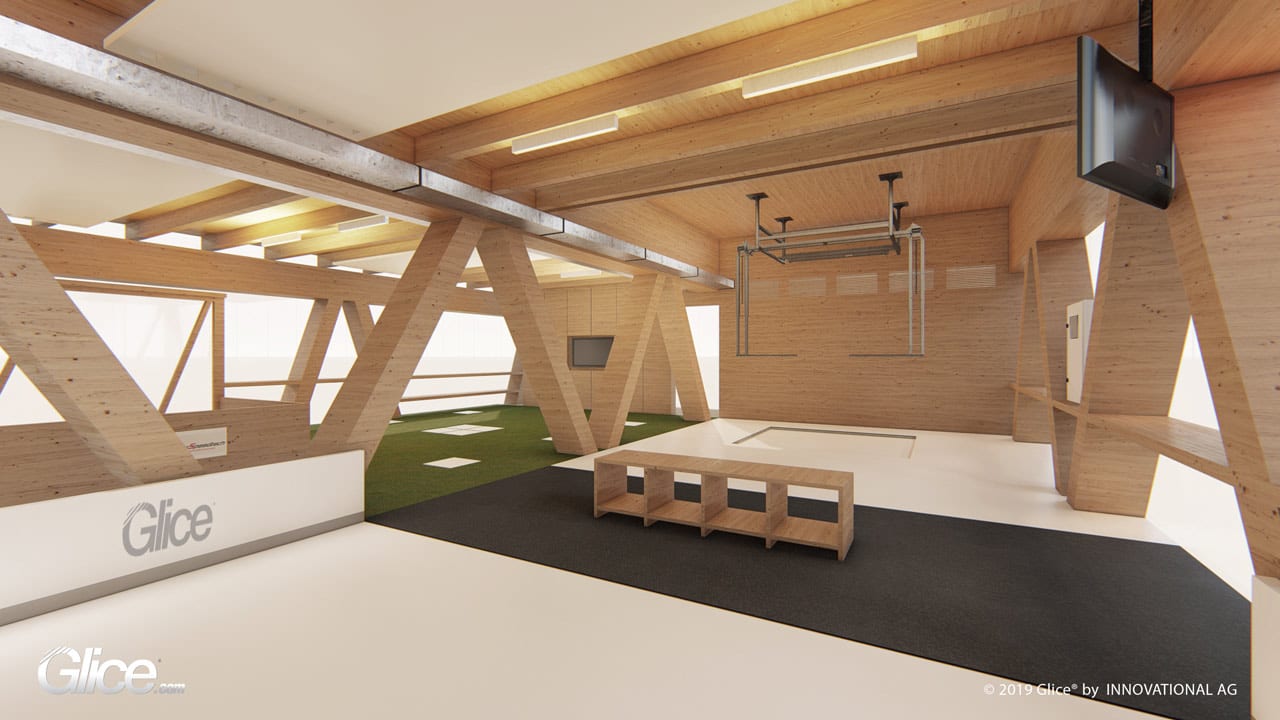
Space
No chillers, no ice handling area and no resurfacer garage. In a small venue that can free up to 40% of the floor area, and the space freed becomes space skated.
“I am not here to say let us hold the next Olympics on Glice. On the contrary. Even as the entrepreneur behind Glice, I find something magical about real ice. It is natural, and I love it. Our goal is that Glice never replaces ice for the big competitions. We see it as complementary.”Viktor Meier, Co-Founder & CEO, Glice AG, addressing the 60th Ordinary ISU Congress
More Hours on the Same Floor.
A second sheet is not only cheaper to build. It is open longer, and it is the same at closing time as it was at opening.
Time on the ice
No twenty minute breaks to resurface. Across a day running from 6am to 10pm, that alone can return around three hours of additional training time.
Consistency
Refrigerated ice softens as a session wears on, and the last skaters get the worst of it. A Glice surface presents the same conditions at the end of the day as at the start.
Where ice was impossible
Panels lay directly on concrete, asphalt or sport flooring, indoors or outdoors, in any climate, with no anchoring and no drilling. Warm and water-scarce regions are exactly where skating has the most room to grow.
See how this works as a permanent facility in the Glice Hockey Center, or for figure skating clubs and academies.
“By enabling more people to experience skating in new locations, such solutions can help introduce new participants to our sport and support its long-term growth worldwide.”Jae Youl Kim, President, International Skating Union
ISU World Congress in Pictures.
Three days at the 60th Ordinary ISU Congress. More photographs from the event are being added.
Presenting to the Congress
The Glice address at the 60th Ordinary ISU Congress
The President on the rink
ISU President Jae Youl Kim at the demonstration rink
Olympians on the surface
Evan Bates and Kaitlyn Weaver on the Congress rink
The rink on the Congress floor
14 m by 14 m, installed below the Congress hall
Delegates on the ice
Member Federation delegates trying the surface between sessions
Demonstration day
The rink in use across the three days of the Congress
Built for Your World. In 100+ Countries.
See how Glice turns any venue into a destination. 3,000+ rinks and counting.
Free Planning Guide
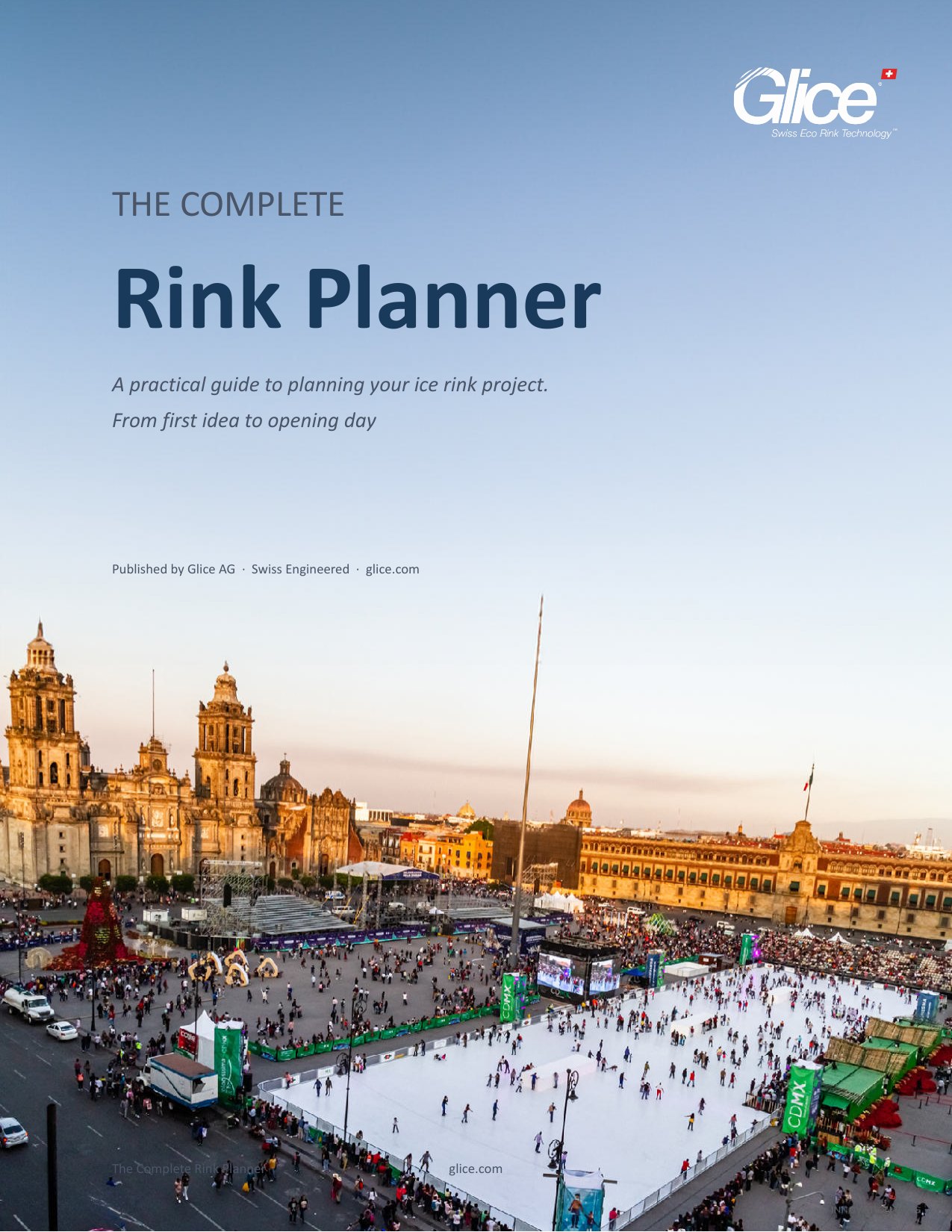
Get The Complete Rink Planner.
Everything you need to evaluate, plan, and launch a synthetic ice rink, in one document.
- Site requirements and Planning Checklist
- Six financing paths, including grants and sponsorship
- How to test, compare, and choose any provider
Frequently Asked Questions
This page includes the video and full written transcript of Viktor Meier’s address in the speech section. The transcript is present in the served page whether its presentation is expanded or collapsed.
Key facts
- Event: 60th Ordinary ISU Congress, Tenerife, Spain, 10 to 12 June 2026.
- Convened by: the International Skating Union, the world governing body for figure skating, synchronized skating, speed skating and short track.
- Scale: 88 ISU Member Federations represented, 280 delegates, three days of sessions.
- Glice's role: invited by the ISU to address the Congress on the future of ice infrastructure for skating, and to install a synthetic ice rink at the venue for delegates to skate.
- Speaker: Viktor Meier, Co-Founder and CEO of Glice AG.
- Skater tests: Olympic ice dancers Kaitlyn Weaver and Evan Bates tested the surface and endorsed it in their own words.
- Independent testing: Fraunhofer IWM measured a friction coefficient equivalent to real ice under laboratory conditions at lower skating speeds, and 52% less friction than the next-best synthetic ice, along with 45% less blade penetration and 6% less abrasion.
- Position: complementary to refrigerated ice, not a replacement for it in major competition.
Sources: “Glice AG Addresses the 60th Ordinary ISU Congress 2026 on the Future of Ice Infrastructure for Skating”, GlobeNewswire, 7 July 2026. “7 Key Takeaways from the Landmark 60th ISU Congress”, International Skating Union. “Inside ISU Congress 2026: What You Need to Know”, International Skating Union. Fraunhofer IWM, Zwischenbericht V1184-2025. Fraunhofer IWM press release on synthetic ice glide properties.