A skatemill—sometimes called a hockey treadmill or ice skating treadmill—lets a player skate in place at game speed indefinitely, without a single foot of ice. For programs that take stride mechanics seriously, it has become one of the standard tools in a hockey-specific training facility, alongside shooting targets and a full-size training rink.
Here is exactly how it works, what it takes to install one, and where it fits into a serious training program.
Skatemill specs at a glance
| Spec | Detail |
|---|---|
| Speed range | 3–30 km/h (1.9–19 mph), forward and backward |
| Incline | Uphill 0–8° (harder effort) / downhill 0–3° (faster-speed training, lower exertion) |
| Usable skating surface | 2400 × 2000 mm / 7.8 × 6.5 ft (2.0 m / 6.5 ft in the direction of skating) |
| Controls | Touch screen or wireless remote, with speed and incline adjustment in real time |
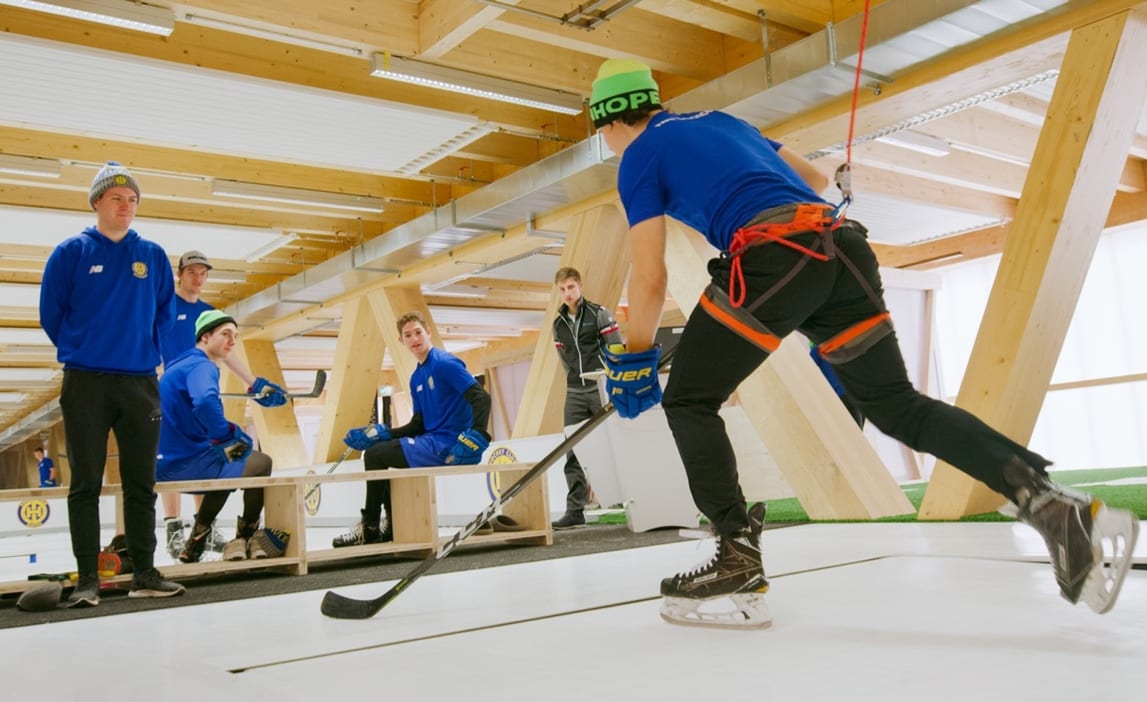
| Safety system | Harness with left-, right-, or both-side handles; automatic micro-switch stop if the skater falls |
| Power requirement | 400V, maximum 32A |
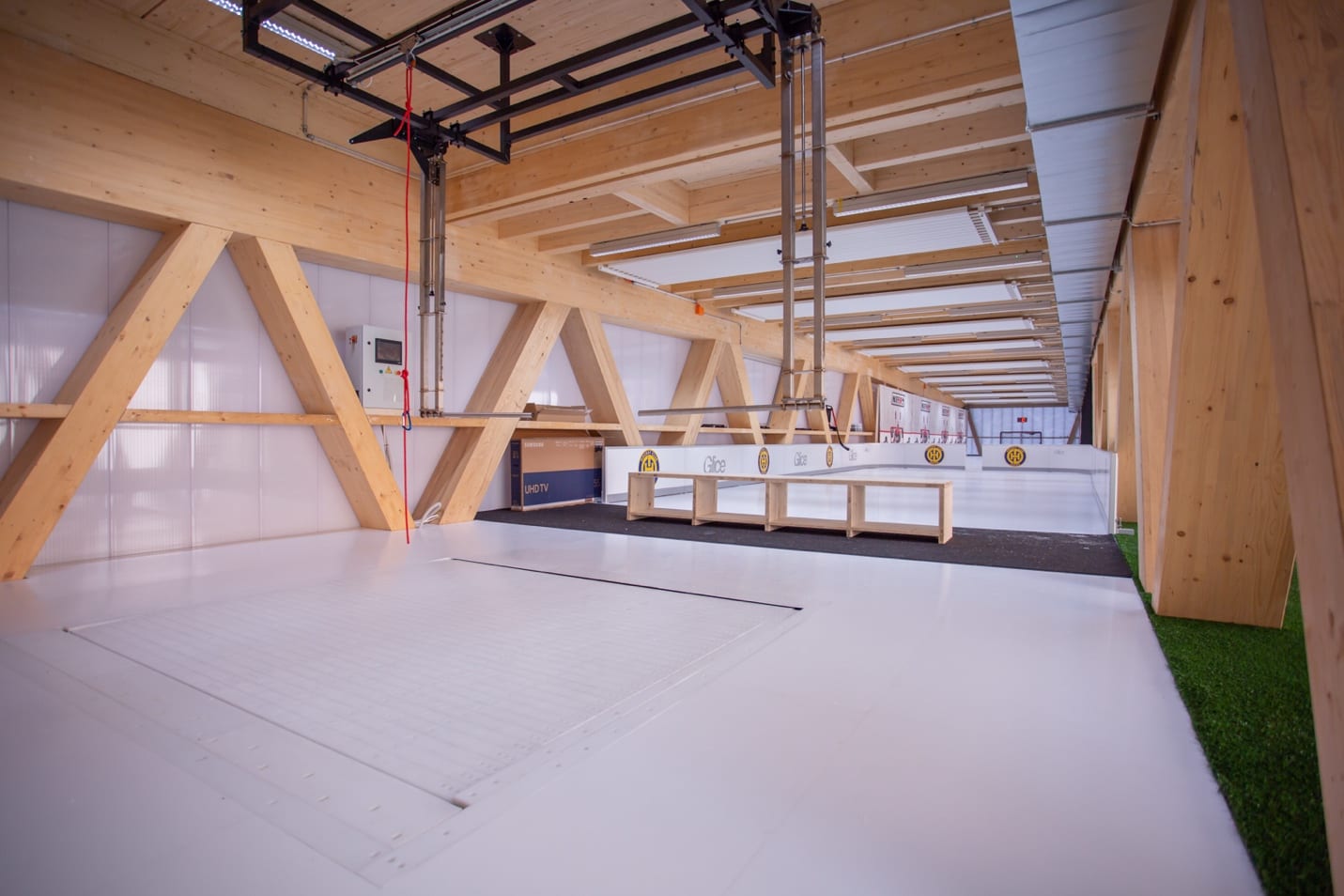
| Installation | Platform or podium around the 850 mm-deep machine; a ceiling height of at least 4 m is recommended |
Why hockey programs use a skatemill
A skatemill isolates stride mechanics the way a running treadmill isolates running form: continuous, controlled, and repeatable in a way that game or scrimmage reps are not. Because the belt runs both forward and backward, it works both skating directions in the same session. The incline range adds resistance training uphill or overspeed training downhill without requiring separate equipment.
The safety harness is what makes this practical for repeated, high-effort sessions. A skater can push to genuine game-speed effort and fatigue without the fall risk that would come with an unsupported treadmill setup.
Real-world example: training centers already using it
Glice's Skatemill is already part of hockey training setups including the Glice Hockey Elite Center at HC Davos, where it sits alongside a full-size training rink as one of the standard stations in a hockey-specific facility. Skatemill Centrum has also built its program around the unit. Their walkthrough below shows it in actual use.
What it takes to install one
The most common installation method is to build a platform or podium around the 850 mm-deep machine. Glice recommends a facility with at least 4 m (13.12 feet) of ceiling height.
The system also requires 400V power with a maximum current of 32A. Glice guides each project through the complete installation process, making this a facility-planning conversation just as much as a purchasing one.
Is a skatemill worth it for your program?
For serious, dedicated training—a hockey academy, an elite training center, or a program built around year-round development—a skatemill earns its place because it delivers volume and repeatability that ice time alone cannot match: no arena scheduling, no ice-time fees, and continuous stride reps at a controlled, adjustable pace.
It is a bigger commitment than a home rink setup, both in space and power, which is why it appears most often in dedicated facilities rather than backyard setups. You will not typically find a commercial skating treadmill for sale with a standard e-commerce price tag. Units are built to custom facility specifications, and pricing depends on the installation footprint, facility power situation, and any additional training equipment around it. That makes this a request-a-quote conversation rather than a listed-price purchase.
The bottom line
- Speed range: 3–30 km/h, forward and backward
- Incline: 0–8° uphill and 0–3° downhill for resistance or overspeed training
- Built-in safety harness with automatic stop
- Requires a platform or podium, at least 4 m of recommended ceiling height, and 400V power with a maximum current of 32A
- Already in use at training centers including the Glice Hockey Elite Center at HC Davos and Skatemill Centrum
Plan the right Skatemill for your facility
Review the complete product specifications and talk with Glice about the space, power, and installation requirements for your training program.
See full specs and request a quoteFrequently asked questions
How fast can a hockey skating treadmill go?
A skatemill typically runs from 3 to 30 km/h (1.9 to 19 mph), supporting both forward and backward skating at any speed in that range.
What is a skatemill used for?
A skatemill (ice skating treadmill) lets hockey players train stride mechanics, speed, and endurance continuously and safely, without needing ice time or a full rink. Incline settings allow both resistance training (uphill) and overspeed training (downhill).
What do you need to install a skating treadmill?
The most common installation method is to build a platform or podium around the 850 mm-deep machine. Plan for a recommended ceiling height of at least 4 m and 400V power with a maximum current of 32A. Glice guides each project through the complete installation process.
Is a skating treadmill safe?
Yes — a skatemill includes a safety harness with left, right, or dual-handle support, and an automatic micro-switch stop that halts the machine immediately if the skater falls.